Condo Defects in Singapore: DLP, Hidden Defects and Who Pays Years Later?
Condo defects in Singapore explained: DLP, developer responsibility, inspections, latent defects, MCST claims and what owners should do.

Condo defects in Singapore explained: DLP, developer responsibility, inspections, latent defects, MCST claims and what owners should do.
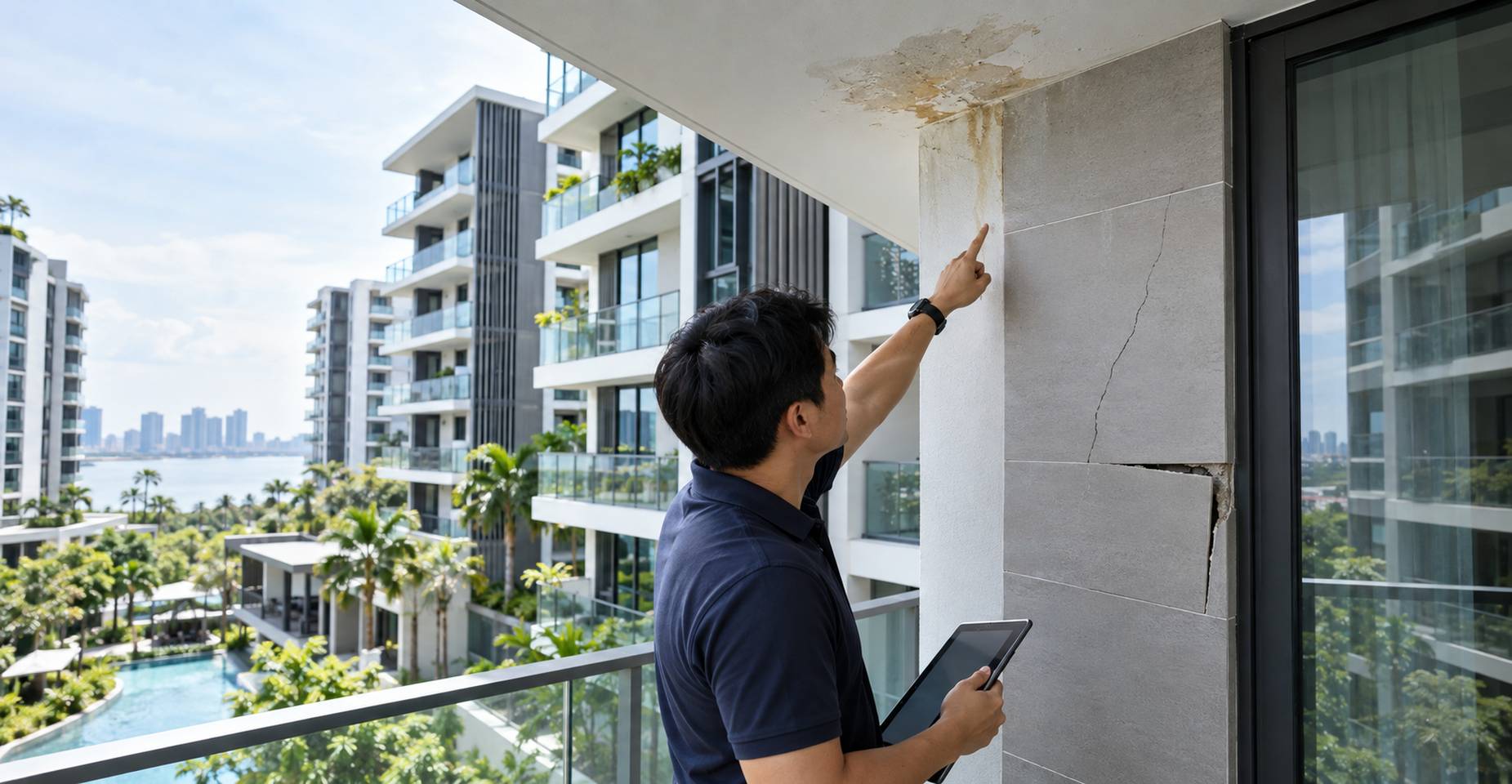
You collect the keys, tap a few tiles, test the taps and spot a hairline crack. Those are the easy defects.
The harder question comes later: what happens when water starts entering the building five years later, balcony glass keeps shattering, or concrete falls from a balcony a decade after completion?
For condo defects in Singapore, the 12-month Defects Liability Period (DLP) is only the first line of defence. What happens next depends on when the defect appeared, whether it was reported, whether it affects your unit or common property, and whether there is still a legally responsible party to pursue.
Inside this guide
For new private housing covered by Singapore's prescribed Sale & Purchase Agreement, a defect includes a fault caused by defective workmanship or materials, or construction that does not follow the agreed specifications. Importantly, the provision can cover the unit, housing project, common property and applicable limited common property.
The DLP lasts 12 months. As at 28 September 2026, the current prescribed agreement still starts that period from the earlier of actual vacant possession or the 15th day after receipt of the prescribed TOP-stage documents. A move from the 15th to the 35th day was announced in November 2025, but the current statutory wording still states 15 days. Buyers should therefore check the operative S&P wording rather than assume the announced change already applies.
And there is an important safety net: BCA states that a defect reported during the DLP remains the developer's responsibility if it is still unresolved after the DLP ends.

Many owners treat key collection as the defects inspection. We think that is too narrow.
Some problems only appear after occupation, repeated use or months of Singapore rain.
Professional inspections can go beyond the naked eye. Depending on the property and inspector, diagnostic tools may include moisture meters, thermal imaging and laser equipment, particularly when investigating water ingress, unevenness or less obvious defects.
Inspect first, renovate second. Once hacking, carpentry, plumbing and electrical works begin, establishing whether damage originated with the developer or your renovation contractor can become considerably harder.
Singapore's prescribed S&P Agreement sets out a specific rectification process.
Once the developer receives your written defect notice, it generally has one month to make good the defect. If it fails to do so, you can give another written notice with a contractor's quotation and your intention to arrange the rectification yourself. The developer then gets another 14 days to carry out the works. If it still does not act, the agreement provides a mechanism for the purchaser to arrange rectification and recover the cost.
That is why photographs, videos, dates, emails, defect numbers and contractor quotations matter. A memory is a story. A timestamped record is evidence.
Day 366 is not a magical developer-immunity switch.
After the DLP, owners normally become responsible for the upkeep of their units. But that does not automatically mean every defect discovered later becomes the owner's problem. The next step is to determine when the defect arose, whether it was previously reported, what caused it and whether it affects the individual unit or common property.
Use the decision tree below as a starting point:
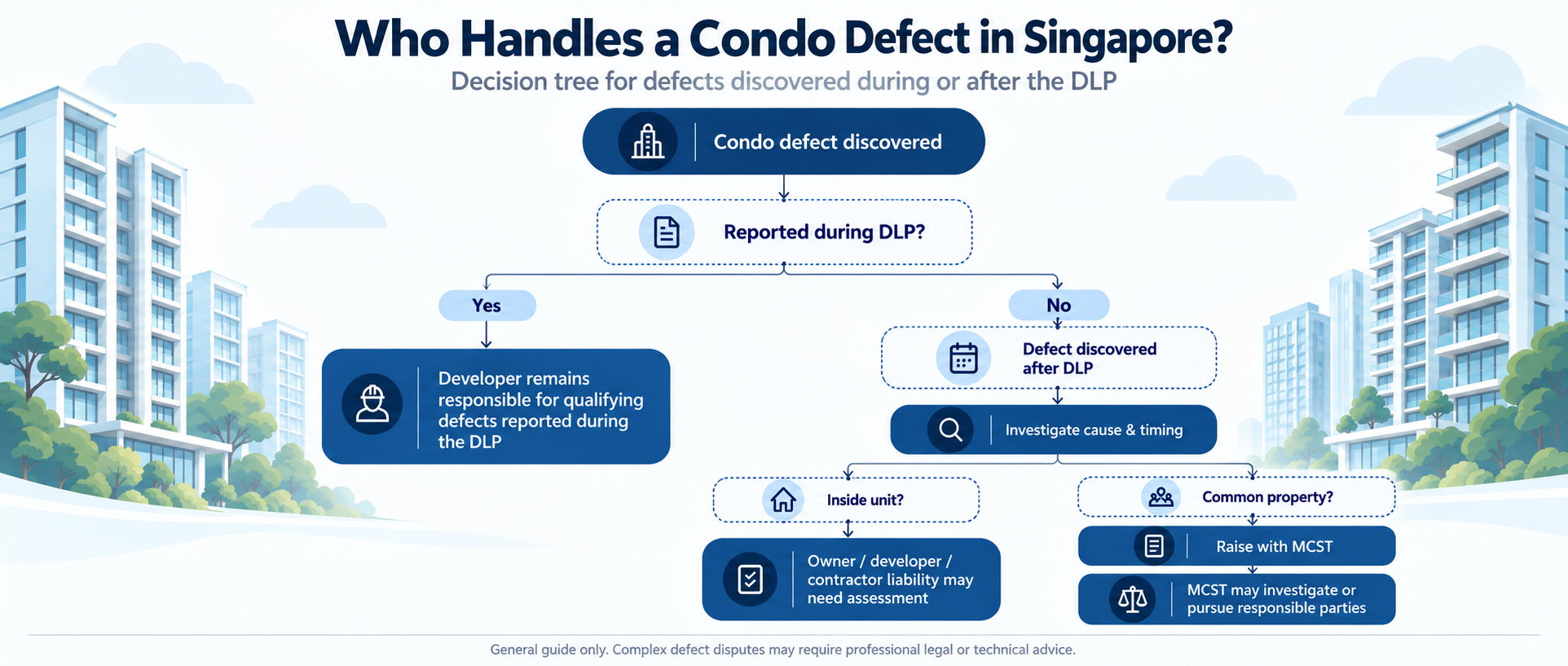
Condo defects Singapore decision tree showing developer responsibility during the DLP and MCST action after the DLP
Figure: A practical decision path for condo defects discovered during or after the Defects Liability Period in Singapore.
If the defect was reported during the DLP but remains unresolved, BCA states that it remains the developer's responsibility for qualifying defects. If the problem only appears later, however, the position becomes more complicated. Owners may need to investigate whether the cause lies with the developer, contractor or another party. Where common property is involved, the MCST may need to coordinate investigations and potentially pursue responsible parties.
Singapore's Limitation Act generally provides a six-year limitation period for actions founded on contract or tort. For certain negligence, nuisance or breach-of-duty claims involving latent damage, section 24A may instead provide three years from the date the claimant acquired the required knowledge, subject to the statutory framework and the 15-year long-stop under section 24B.
Recent cases show why this distinction matters.
At Foresque Residences, which obtained TOP in 2014, a cementitious piece allegedly detached from a third-floor balcony in February 2025 and fell about 20 metres. An engineer engaged by the MCST later identified 88 balconies in one block as allegedly affected. The MCST has sued the developer and four other parties, while the defendants dispute responsibility and aspects of the claim.
At Canberra Residences, residents had reported problems from around 2013. A settlement was reached in 2020, yet the MCST is again litigating over allegedly unresolved defects including water seepage, ponding and balcony glass. Around 400 of more than 4,000 glass panels were reported to have shattered over time. The contractor disputes the MCST's allegations.
Then there is Waterwoods EC. Building defects including external-wall cracks and water seepage emerged years after TOP. Its project developer was dissolved in 2020 and the main contractor became insolvent in 2021. The MCST later asserted S$3.9 million in rectification costs while seeking to revive the dissolved developer.
BCA data reported by The Business Times provides an interesting clue.
Across 167 private residential projects assessed over six years, 48 received lower CONQUAS Bands 4 to 6. Of those, 28 were small developments, typically with fewer than 50 units. Small developments therefore represented about 58% of the lower-rated group, compared with only around 14% of projects rated Bands 1 to 3.
This does not prove that a boutique condo will have defects. But it makes construction track record a worthwhile due-diligence item.
BCA's Quality Housing Portal lets buyers check project, developer and builder CONQUAS bandings. Band 1 represents a very low incidence of major defects, while Band 6 represents an unsatisfactorily high incidence.
A leak inside your apartment may actually originate from the façade, roof or another area of common property.
Under the Building (Strata Management) Act, the MCST has duties to control, manage, maintain and repair common property. That makes the MCST central when defects affect façades, roofs, shared waterproofing, basement areas, pools or other common elements.
For serious building-wide defects, the issue can therefore move from “my unit has a problem” to “our development may have a construction problem.”

From 22 May 2026, Singapore introduced stronger consequences for seriously errant developers.
Developers responsible for severe safety-related regulatory non-compliance or qualifying major defects can face land-sales disqualification and/or suspension of sales privileges for future projects for up to five years. Authorities consider factors including severity, rectification speed and impact on homeowners.
This does not extend your DLP. Instead, it adds a much larger regulatory hammer behind Singapore's construction-quality regime.
Before buying: check BCA's Quality Housing Portal and consider a pre-purchase inspection for an older home.
At key collection: inspect, photograph and report before renovation.
After rectification: inspect again.
Before the DLP expires: inspect again. Rain, occupation and time can expose defects Day 1 cannot.
Years later: investigate serious or recurring defects promptly. Legal clocks keep running even while cracks sit quietly in concrete.
Twelve months can pass quickly. A defect can last considerably longer.
From price insights to viewings and offers, Kucing helps owners, agents, buyers, and tenants move through property decisions with more clarity and control.

.png)