Buying in 2027 ? Home Loan Singapore Guide: Rates, SORA, HDB vs Bank & Mortgage Tip
Compare Singapore home loan rates, HDB vs bank loans, SORA, TDSR, refinancing and fixed vs floating mortgages before buying in 2027

Compare Singapore home loan rates, HDB vs bank loans, SORA, TDSR, refinancing and fixed vs floating mortgages before buying in 2027

A home loan in Singapore is not simply about finding the lowest interest rate.
You may be committing to a mortgage for 20 to 30 years, so the right loan should fit your income, cash reserves, CPF strategy, property plans and ability to cope when interest rates change.
And heading into 2027, rates have become interesting again.
Mortgage rates fell sharply from their earlier peaks, with SORA settling around the low-1% range during 2026. But on 16 September, the US Federal Reserve raised rates by 0.25 percentage point, its first increase since 2023. Singapore does not automatically follow the Fed, but global funding conditions can influence SORA and bank mortgage pricing here.
So instead of trying to predict exactly where rates go next, build a home loan that can survive more than one interest-rate scenario.
Start with the home you can afford, not the maximum amount a bank is willing to lend you.
Your purchase budget needs to cover far more than the monthly mortgage: downpayment, Buyer’s Stamp Duty, Additional Buyer’s Stamp Duty where applicable, legal costs and renovation, followed by property tax, insurance, maintenance fees or conservancy charges.
Singapore’s MoneySense also recommends budgeting for potential future interest-rate increases if you take a floating loan.
A simple stress test helps:
Can you still comfortably service the mortgage if your interest rate rises by 1 percentage point?
Borrowing capacity is a ceiling. It does not have to become your budget.
Two acronyms have an unusually large influence on how much you can borrow in Singapore: TDSR and MSR.
Two acronyms have a major influence on how much you can borrow.
The Total Debt Servicing Ratio (TDSR) generally limits total monthly debt repayments to 55% of gross monthly income for property loans subject to the framework. This includes your mortgage plus commitments such as car loans and other credit obligations.
The Mortgage Servicing Ratio (MSR) limits the monthly housing instalment to 30% of gross monthly income for HDB flats and applicable Executive Condominium purchases.
These are regulatory limits, not recommended spending targets.
Your own comfortable mortgage level may be considerably lower.
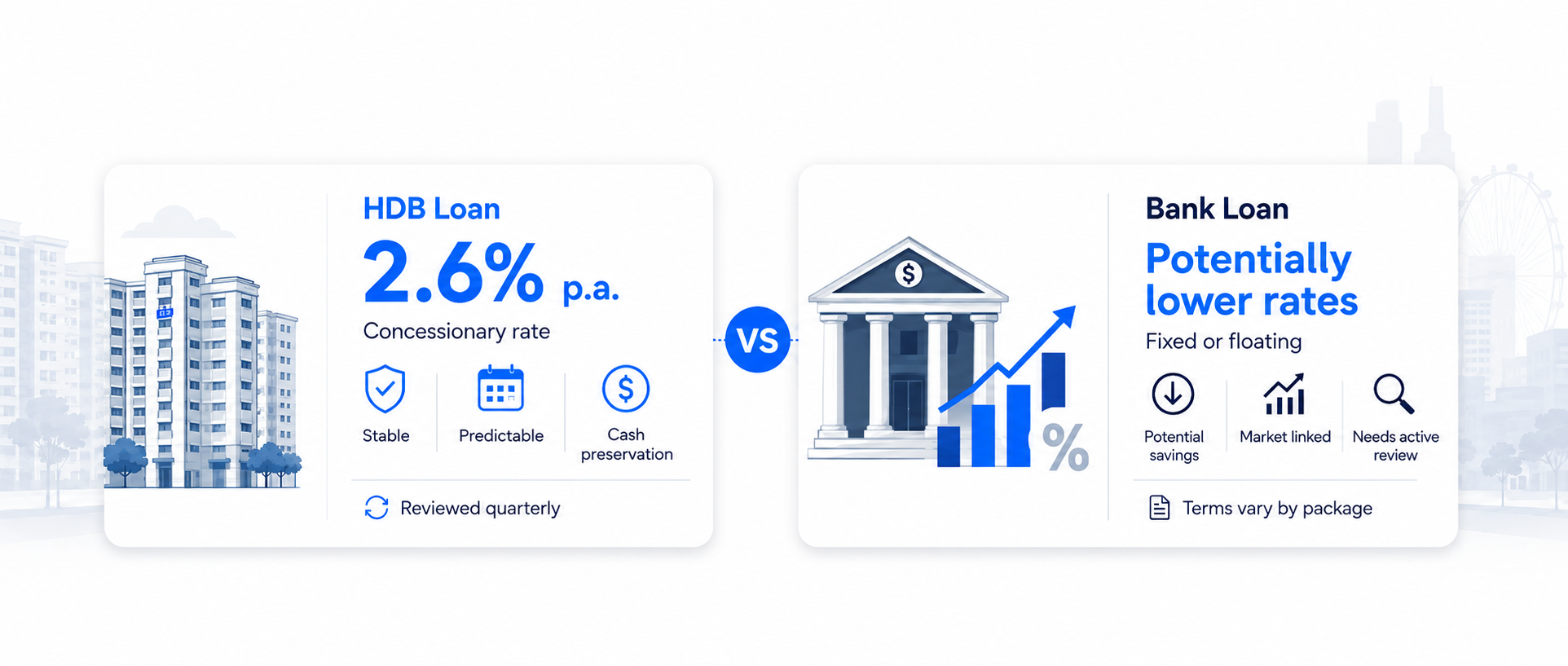
Eligible HDB buyers can choose between an HDB concessionary loan and financing from a bank or other regulated financial institution.
As at September 2026, the HDB concessionary rate remains 2.6% p.a. It is pegged at 0.1 percentage point above the prevailing CPF Ordinary Account rate.
HDB's current maximum LTV is up to 75%, subject to eligibility and remaining-lease conditions.
There is also an important 2026 update.
For eligible buyers applying for an HFE letter from 24 August 2026, the monthly household income ceiling for an HDB housing loan increased from S$14,000 to S$16,000 for families, and from S$7,000 to S$8,000 for eligible singles aged 35 and above.
One rule deserves a highlighter: you can refinance an HDB loan into a bank loan later, but once you move to bank financing, you cannot switch that mortgage back to an HDB concessionary loan.
Loan-to-Value, or LTV, determines how much of your property price can be financed with debt.
For a bank residential property loan with no outstanding housing loan, the maximum LTV can generally reach 75%, subject to loan tenure, age and other lending conditions. At 75% LTV, at least 5% generally needs to be paid in cash.
If you already have one or more housing loans, the permitted LTV falls significantly.
For an HDB resale purchase using an HDB loan, financing can reach 75% of the lower of the purchase price or HDB valuation, subject to eligibility.
There is another little trap hiding in plain sight: Cash Over Valuation.
If you agree to buy an HDB resale flat for more than HDB's valuation, that difference is not covered by the housing loan or CPF usage and has to be paid in cash. So a S$900,000 purchase price does not necessarily mean the bank or HDB will calculate financing from S$900,000.
The valuation still matters.
This is where the story has changed.
The rate outlook shifted again in September 2026. As of mid-September 2026, 3-month compounded SORA was around 1.2%, while some advertised mortgage packages started around 1.35%-1.40%. These are snapshots rather than forecasts: mortgage pricing can change quickly as banks respond to funding costs, competition and expectations for future rates.
The US Federal Reserve raised its policy rate by 0.25 percentage point on 16 September, its first increase since 2023, taking the target range to 3.75%–4.00%. For Singapore borrowers, that does not mean mortgage rates automatically rise by the same amount. But higher US rates can influence global funding conditions and, eventually, SORA and local bank pricing. Some Singapore banks had already raised fixed mortgage rates by around 0.10 to 0.25 percentage point ahead of the Fed decision.
That changes the question for buyers.
Instead of: “How low can mortgage rates go?”, ask: “Would this loan still work for me if rates rise again?”
A promotional rate is only the opening scene of a 20- or 30-year mortgage.
Want to see what the numbers look like for your own loan?
Financing should come before commitment, not after the champagne emoji has already entered the family WhatsApp group.

CPF Ordinary Account savings can reduce the amount of cash you need to put into a property and can also be used for eligible mortgage repayments.
But using CPF is not economically free.
Money taken from your CPF OA for housing is money that is no longer earning interest inside the account.
When you eventually sell the property, you generally have to refund the CPF principal withdrawn plus accrued interest from the sale proceeds back into your CPF account. That does not mean using CPF for housing is a bad idea. It means you should make the decision deliberately.
Cash preserves CPF savings and their compounding but reduces your liquid reserves today. Using CPF preserves more cash but can affect the cash proceeds you eventually receive when the property is sold.
For buyers taking an HDB housing loan, HDB currently allows each buyer to retain up to S$20,000 in the CPF OA, with the remaining available OA balance generally used towards the flat purchase before the HDB loan is disbursed.
A good financing plan therefore asks two separate questions:
How much CPF can I use?
[ Estimate how much Ordinary Account savings you can use for a property purchase here: CPF usage tool calculator ]
And:
How much CPF should I use?
Those are not always the same number.
The 2026 rate environment is not only relevant to new buyers.
If your lock-in period is ending, compare:
Stay → Reprice → Refinance
Start by asking your existing bank what repricing options are available. Then compare them with competing packages.
CNA's mortgage experts similarly noted after the September Fed hike that homeowners approaching the end of their lock-in periods should review their loans, while taking into account penalties, legal and valuation costs, clawbacks and the remaining loan balance.
Saving 0.2% on paper is less exciting if moving the loan costs thousands of dollars.
The best home loan in Singapore is not automatically the mortgage offering the lowest rate today.
Heading into 2027, Singapore mortgage rates remain low compared with the 2022-2024 rate cycle, but the direction is no longer obviously downward.
The September Fed hike, the possibility of further tightening and Singapore's recent inflation pickup are reminders that borrowers should not build a 20- or 30-year financing plan around today's promotional rate.
Compare your mortgage under at least three scenarios:
today's rate → a higher-rate scenario → the post-promotional rate
Then consider your cash reserves, CPF strategy, property holding period and ability to refinance.
Once the numbers work, you can move from financing to finding the right property.
On Kucing, buyers can explore homes and market prices, organise their shortlist, book viewings and keep their property journey in one place.
Start with the budget. Understand the loan. Then find the home that fits both.
Rates and loan packages change frequently. Figures in this article are for general information and should be checked with HDB, MAS or the relevant financial institution before making a financing decision.
From price insights to viewings and offers, Kucing helps owners, agents, buyers, and tenants move through property decisions with more clarity and control.