Buy, Retire or Build a Business? The Singaporean’s Johor Property Guide
Johor Property 2027: Investment, Second Home, Retirement or Retail Opportunity?

Johor Property 2027: Investment, Second Home, Retirement or Retail Opportunity?
.jpg)
Johor's story is getting stronger, but also more complicated. It is no longer merely Singapore’s weekend escape hatch.
The RTS Link remains targeted for passenger service at the end of 2026. Johor attracted RM59.4 billion of approved investment in H1 2026, while the JS-SEZ is building a deeper Singapore-Johor economic corridor. Yet supply remains a major risk: Johor also had Malaysia's largest stock of completed unsold residential units and serviced apartments in H1 2026.
That is why buying “Johor” is the wrong question. The real question is what you are buying, where, for whom and why.
The Johor Bahru-Singapore RTS Link remains officially targeted to commence passenger service at the end of 2026, although buyers should treat that as a project target rather than assume a fixed opening date. It will connect Bukit Chagar with Woodlands North in about five minutes and is designed to carry up to 10,000 passengers per hour in each direction.
Its strongest property effect should therefore be highly localised. A development genuinely walkable to Bukit Chagar is not the same investment proposition as one advertised as “near RTS” but requiring a 15-minute drive through JB traffic. The train solves the cross-border segment, not the journey from every Johor development to Bukit Chagar. Local traffic, last-mile transport and parking could remain serious friction points after operations begin.
The 3,588 sq km Johor-Singapore Special Economic Zone (JS-SEZ) encompasses nine flagship areas and 11 promoted sectors. Under the bilateral framework, Singapore and Malaysia aim to facilitate 50 projects within five years and 100 within ten, with an intention to create 20,000 skilled jobs. Johor's state leadership has separately articulated a broader ambition for the zone to contribute RM260 billion in GDP by 2030
For pure investment, we should ignore the showroom sparkle and analyse three numbers:
The most common trap is buying a generic high-rise unit because it looks inexpensive in Singapore dollars. Oversupply, competing new launches and weak owner-occupier demand can flatten resale performance. A strong investment normally needs a genuine demand engine such as the RTS corridor, a major employment cluster, an established international school or a functioning commercial district.
The biggest risk isn't necessarily price. It is supply.
Johor remains a highly uneven market. NAPIC's H1 2026 data recorded 4,222 completed unsold residential units and 9,946 unsold serviced apartments in Johor, the highest totals in Malaysia for both categories. That doesn't mean every Johor condo is oversupplied. A genuinely walkable RTS property, landed home in an established neighbourhood and investor-oriented serviced apartment can have completely different demand pools. But it does mean buyers should be suspicious of generic high-rise projects sold mainly on future infrastructure, lifestyle renderings or Singapore price comparisons.
Financing is property- and borrower-specific. Malaysian banks can lend to Singapore-based buyers, but permitted loan-to-value ratios, age limits, income recognition and debt-service calculations vary materially between banks. Buyers earning SGD but borrowing MYR also carry currency exposure for the life of the loan.
Malaysia's Overnight Policy Rate was 2.75% as at 3 September2026, after remaining unchanged throughout 2026 so far, but the mortgage rateoffered to an individual foreign buyer will depend on the bank and borrowerprofile
Before buying, check the completed competing supply, incoming pipeline, actual occupancy, achieved rents and recent resale transactions within the immediate micro-market.
.webp)
Johor may be more convincing as a lifestyle asset than as a spreadsheet investment.
A second home can provide more space, weekend access, affordable dining and a different pace without requiring a flight. It may suit families who frequently visit Johor, have relatives in Malaysia or want a larger home for holidays and remote work.
However, ownership does not remove border logistics. Singapore vehicles entering Malaysia must comply with the Vehicle Entry Permit system, while travellers should check current immigration and Malaysia Digital Arrival Card requirements before each trip.
The best second home is therefore not necessarily the property with the highest projected rental yield. It is the one we will actually use.
Johor combines lower everyday costs with proximity to Singapore-based family, banking and professional networks. Private hospitals are also attracting Singapore residents for health screening and elective care, while retirement and assisted-living options across Malaysia are gaining attention.
Long-term residence requires more than buying a unit. Malaysia My Second Home provides renewable social-visit passes under Silver, Gold, Platinum and SEZ/SFZ categories.
Federal MM2H currently provides:
There is a 90-day annual stay requirement. Property purchase is compulsory, and the MM2H property generally cannot be sold for 10 years, except to upgrade to a more expensive property. For the SEZ/SFZ category, MOTAC says the property must be bought directly from a developer, with the floor price subject to Johor's acquisition rules.
Buying property and qualifying for MM2H are two separate questions. A property that a foreigner is legally allowed to buy does not automatically satisfy a particular MM2H category, and an MM2H minimum property value does not necessarily override Johor's normal foreign-acquisition rules.
MM2H is not permanent residence or citizenship. Buyers should also assess medical insurance, access to hospitals, estate planning and whether they can comfortably manage daily life without driving. Singapore is even reviewing its Overseas MediSave arrangements ahead of the RTS opening as cross-border healthcare demand grows, although buyers should not assume any future expansion until policy changes are confirmed
The economic story is beginning to move beyondannouncements. Johor secured RM59.4 billion of approved investment in the firsthalf of 2026, making it Malaysia's second-largest investment destination duringthe period. About RM46.3 billion came from foreign investment.
That supports the longer-term employment and commercial-demand thesis, but approved investment should not be confused with occupied factories, offices or rented homes. The property benefit appears only when projects are implemented and jobs actually materialize.
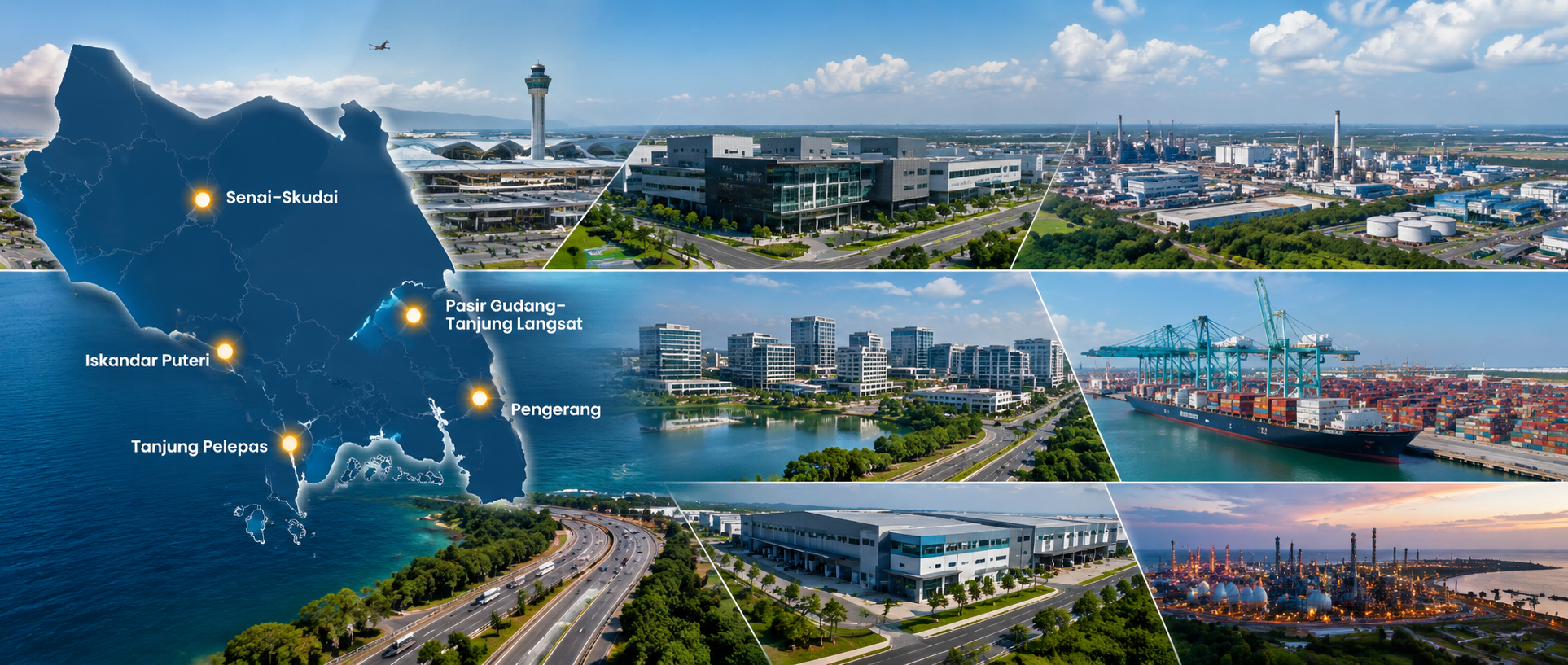
The JS-SEZ makes Johor a more credible business story, particularly in Senai-Skudai, Iskandar Puteri, Tanjung Pelepas, Pasir Gudang-Tanjung Langsat and Pengerang. These areas serve different economic functions, so buying “near the SEZ” is too vague to be a strategy.
Retail property should follow people, not press releases.
We should look for:
The SEZ may produce long-term commercial opportunities, but infrastructure delivery, workforce mobility and business execution will decide which districts benefit first.
JB City Centre / Bukit Chagar
RTS-linked commuting, urban rental demand and amenities. Here, walkability to the station matters enormously.
Iskandar Puteri / Medini
International schools, healthcare and larger master-planned communities. More naturally suited to family lifestyle and second-home use than daily RTS commuting.
Senai / Kulai / Sedenak
Airport, manufacturing, logistics and data-centre activity. The investment thesis is employment-led, so tenant profile and actual job creation matter more than weekend Singapore traffic.
Pasir Gudang / Tanjung Langsat
Industrial/logistics economy. Very different property demand from central JB.
Forest City
Needs its own category because of the Special Financial Zone and MM2H/tax arrangements. It shouldn't simply be bundled into the wider Iskandar story.
Buying became more expensive for foreigners in 2026.
Singaporeans are treated as foreign purchasers in Malaysia. In Johor, foreigners generally face a minimum purchase price of RM1 million, although special-zone exemptions or project-specific rules must be verified before signing.
From 1 January 2026, non-citizens and foreign companies buying residential property in Malaysia generally face a flat 8% stamp duty on the instrument of transfer, based on the higher of the purchase consideration or market value. For a RM1.5 million home, that alone can mean RM120,000 in transfer duty.
Johor generally also applies a RM1 million minimum purchase price for foreign interests for qualifying residential properties, whether buying from a developer or on the subsale market. Certain schemes or special-zone arrangements can operate differently, so obtain a written acquisition-cost calculation from a Malaysian conveyancing lawyer before paying a booking fee.
For Singapore HDB owners, Johor is not outside the HDB rulebook. HDB treats overseas private residential property as private-property ownership, so owners must fulfil the applicable MOP before buying.
Exit costs matter too. Foreign owners generally face Malaysian Real Property Gains Tax of 30% on taxable gains when selling within the first five years and 10% from the sixth year onwards. That makes short-term flipping a very different proposition from holding a Johor property as along-term second home or income asset. Special preferential rules apply in certain designated areas, including Pulau 1 of Forest City.
Johor Bahru and Bukit Chagar suit buyers prioritising RTS access, urban amenities and rental liquidity.
For anything sold on the RTS narrative, check:
- Actual walking distance from building entrance to Bukit Chagar, not straight-line distance.
- Whether the walking route is covered, safe and pedestrian-friendly.
- Whether a car/Grab/feeder bus is still required.
- Total door-to-door commute to the person's Singapore workplace.
- Price premium versus comparable properties farther from RTS.
- Whether current rents justify that premium before speculative future appreciation.
Iskandar Puteri and Medini offer international schools, healthcare, family attractions and larger master-planned developments. They may suit second-home and family-lifestyle buyers better than daily Singapore commuters.
Senai and Kulai benefit from airport access, manufacturing and data-centre or technology activity. They are more employment-led than tourism-led.
Pasir Gudang and Tanjung Langsat are industrial corridors. Their property case depends on local employment, logistics and business demand rather than Singapore lifestyle buyers.
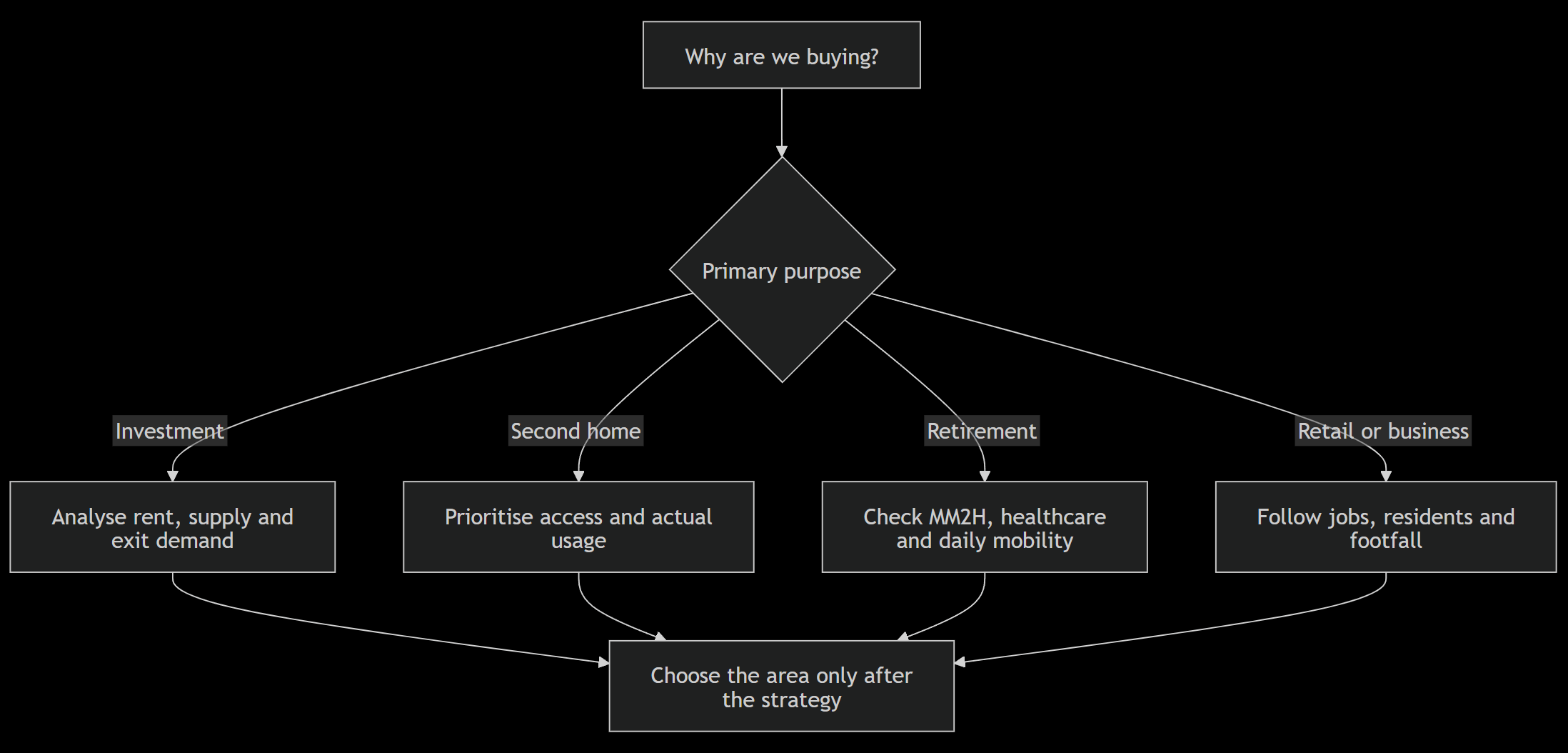
Johor property can be a sensible purchase, but the winning argument differs by buyer.
For investment, we need disciplined pricing and durable tenant demand. For a second home, usefulness matters more than theoretical yield. For retirement, visa, healthcare and mobility are central. For retail, completed economic activity beats future promises.
Before looking across the Causeway, we should also compare what the same capital could achieve in Singapore. Kucing’s Unified PropSpace helps owners and buyers explore market data, listings, viewings, chats and offers from one connected dashboard.
From price insights to viewings and offers, Kucing helps owners, agents, buyers, and tenants move through property decisions with more clarity and control.