New En Bloc Cycle Singapore 2027: Why the Next Wave May Look Nothing Like 2017
Singapore's en bloc rules have changed. What lower thresholds, ageing condos and new 2026 sale attempts could mean for owners in 2027

Singapore's en bloc rules have changed. What lower thresholds, ageing condos and new 2026 sale attempts could mean for owners in 2027
A decade after Singapore’s great collective-sale surge began, en bloc is creeping back into the property conversation. But we should be careful with the word “boom”.
The ingredients entering 2027 look very different from 2017. Singapore has a growing stock of ageing condos, maintenance costs are rising, major collective sales are returning, and the Government is proposing changes that could make redevelopment of older estates easier.
From 29 July 2026, qualifying large en bloc redevelopments yielding 700 to 1,399 homes can receive six years to complete and sell, while projects yielding at least 1,400 homes can receive seven years. To qualify under these large-site categories, redevelopment must also increase the number of homes to at least 1.5 times the existing unit count. Mega projects must sell at least half their units by the end of year six.
For homeowners, this may signal something more structural than another property frenzy: a new en bloc cycle increasingly tied to urban renewal.
In this guide
Singapore’s en bloc market peaked spectacularly in 2017 and 2018. ERA recorded about S$8.7 billion of collective sales in 2017 and S$10.8 billion in 2018. By comparison, the strongest year since then produced just S$3.6 billion.
Activity is now stirring again. Loyang Valley sold for S$880 million in April 2026, while Thomson View secured an S$810 million collective sale after previous failed attempts.
The numbers still sit far below 2017 levels. That is precisely why we see 2027 as potentially the start of a new cycle, rather than another speculative stampede.
The old cycle was largely fueled by developers replenishing depleted land banks.
The emerging cycle has another ingredient: age.
More than 1,000 of Singapore’s roughly 3,750 private residential developments are already at least 30 years old. Around 20,000 private non-landed homes are in developments more than 40 years old.
Government Land Sales remain easier for developers because they carry fewer ownership, demolition and legal complications. So an old condo is not automatically buried treasure. The redevelopment numbers still need to work.
A major uncertainty has now been removed. Parliament passed amendments to the Land Titles (Strata) Act on 8 September 2026, introducing lower consent thresholds for older developments while strengthening safeguards around repeated collective-sale attempts.
Developments aged 40 to 59 years will require 70% consent, while those aged 60 years or older will require 65%. The existing 90% threshold for developments below 10 years and 80% threshold for those aged 10 to 39 years remain unchanged.
The reforms also make it harder to launch weakly supported or repeated campaigns. At least 35% initial support will be needed to start a collective-sale exercise, the period for collecting CSA signatures will fall from 12 months to six months, and the restriction period following a failed attempt will increase from two years to three.
However, passing the law and commencing it are not the same thing. The amendments take effect on a date appointed by the Minister, so owners involved in an active sale process should still confirm which framework legally applies to their estate.
Amendment Bill proposes a more age-sensitive framework:
For ageing estates, that is a substantial change.
Under the reforms passed by Parliament on 8 September 2026, a development aged 40 to 59 years will require 70% consent for a collective sale, while a development aged 60 years or more will require 65%. The existing thresholds remain unchanged for younger developments: 90% for those below 10 years old and 80% for those aged 10 to 39 years.
That means a 45-year-old condominium that currently requires 80% support would require only 70% once the new provisions take effect.
But the changes are not simply about making en bloc sales easier.
At the same time, the legislation introduces stronger controls over how collective-sale exercises are started and repeated:
There is another safeguard for objecting owners. The legislation also increases the limit on additional sale proceeds that the High Court may order to be paid to an objector in appropriate circumstances, from 0.25% to 0.5% of the sale proceeds for the unit, or S$2,000, whichever is higher. This is not an automatic payment, but an additional remedy available where the Court considers an increase just and equitable.
The result is a more nuanced framework.
Older developments will have a lower hurdle to clear where a substantial majority of owners want to sell, while it will become harder for relatively small groups of owners to repeatedly start collective-sale exercises without broader support.
Another change has received considerably less attention.
The legislation expands the majority-consent collective-sale regime to certain wholly residential, non-strata-titled private developments where individual flat owners hold registered leases of less than 850 years but do not own the underlying land.
At present, developments of this type generally fall outside the standard collective-sale regime, meaning a sale requires unanimous agreement among the relevant flat owners and landowner.
Under the new section 84FC, eligible developments will be able to use the same age-based majority thresholds, subject to safeguards protecting the interests of the underlying landowner.
The pool is relatively small. MinLaw identified five developments expected to fall within the new framework: Neptune Court, Townhouse Apartments, Orchard Court, One Tree Hill Mansions and Paterson Court. All are more than 40 years old, and the underlying land is owned by the Minister for Finance (Incorporation). Developments on HDB-owned land are excluded from this new provision.
This is the biggest update since the reforms were first announced.
The Land Titles (Strata) (Amendment) Bill received its First Reading on 4 August 2026 and was subsequently passed by Parliament on 8 September 2026.
However, owners should not start applying the new 70% or 65% thresholds yet.
The legislation provides that the amendments will come into operation on a date appointed by the Minister and published in the Gazette. As of 19 September 2026, the new collective-sale thresholds have not yet commenced.
There are also transitional rules for en bloc exercises already under way.
Broadly, where the first signature to an existing Collective Sale Agreement was obtained before the new rules commence, the existing framework will continue to apply. For developments aged 40 years or more that are already gathering signatures, there will also be an option to terminate the existing agreement and start afresh under the new framework. Such developments will have seven months from the commencement date to obtain the required consent under the new rules.
For owners already involved in a live en bloc exercise, the timing therefore matters. They should look at the specific status of their development rather than assuming the new thresholds already apply.
The owner-consent reforms are only half of the picture.
For qualifying large en bloc sites acquired on or after 29 July 2026, the Government has also extended the ABSD remission timelines available to housing developers.
A qualifying redevelopment yielding 700 to 1,399 homes can receive up to six years to complete the project and sell the units, while a qualifying mega development yielding at least 1,400 homes can receive up to seven years. To qualify under these categories, the redevelopment must also produce at least 1.5 times the number of residential units in the existing development.
For mega projects, there is an intermediate condition: developers must sell at least 50% of the residential units within six years. They must then complete the development and sell all the units within seven years to obtain the full remission.
Previously, the sheer scale of a large redevelopment could itself increase the risk for a developer. Acquiring and demolishing hundreds of existing homes, rebuilding a substantially larger project and then selling perhaps more than 1,000 new apartments within a tight ABSD timeline made very large en bloc sites harder to price.
Extra time does not turn an overpriced site into a viable acquisition.
But it removes one constraint from the equation.
Put the two policy changes together and the direction is clear: lower the collective-sale hurdle for genuinely older developments, give developers more time to redevelop very large sites, but strengthen safeguards around how collective sales are initiated and repeated.
For many owners, the debate is becoming less about an imaginary en bloc jackpot and more about a very real bill downstairs.
Older developments eventually face lifts, façades, waterproofing, plumbing, electrical infrastructure and larger sinking-fund requirements. Property managers increasingly describe a crossroads around the 25-year mark: upgrade the estate or consider redevelopment.
Pine Grove's collective sale committee has estimated that major estate repairs and replacements could eventually cost around S$15 million to S$21 million, equivalent to roughly S$22,000 to S$32,000 per unit. Monthly maintenance fees have already risen from about S$318 to S$480.
This is the less glamorous side of the en bloc equation. At some point the comparison is no longer simply “current home versus possible windfall”. It becomes renew the building, or renew the land beneath it?
Maintain? Upgrade? Sell individually? Or collectively redevelop?
There is another piece to the urban-renewal puzzle.
En bloc does not necessarily have to mean demolish everything and start again.
As Singapore’s building stock ages, adaptive reuse is gaining more attention. Instead of completely replacing an existing building, a structurally suitable property can sometimes be retained and converted to a new use.
The economics still have to make sense, and adaptive reuse will clearly not suit every ageing residential estate. Building configuration, structural condition, planning requirements, ownership structure and redevelopment potential all matter. The Business Times highlighted this wider question in August 2026 as Singapore considers how best to rejuvenate older buildings.
Golden Mile Complex offers a prominent example of another path.
Rather than simply disappearing after its collective sale, the conserved former Golden Mile Complex is being adapted for office and retail uses, alongside a new residential tower. URA specifically highlights the project as part of Singapore's approach to giving older buildings new uses while retaining significant parts of the existing built environment.
For most ordinary ageing condos, full redevelopment may still provide the clearest route when the site is significantly under-utilised.
But the bigger principle is worth remembering:
Urban renewal does not always have to mean demolition.
As more buildings reach 40, 50 and 60 years of age, Singapore may increasingly have to decide not only whether an old property should be renewed, but how.
Recent cases show why there is no simple en bloc formula.
- Loyang Valley: pricing realism can unlock a deal
The 362-unit development succeeded on its third attempt at S$880 million, around S$100 million below its previous 2022 asking price.
- Thomson View: price matters.
Its reserve price began at S$918 million. A deal eventually emerged around S$810 million after the price was revised lower and sufficient owner consent was obtained.
- Lakeside Towers: redevelopment potential matters.
The 144-unit Jurong development is making its third attempt at S$350 million. Its site could potentially accommodate about 395 new apartments, illustrating why under-utilised older sites attract attention.
- Pine Grove: regulation can change the owner-consensus equation
Pine Grove may become the clearest real-world test of Singapore's collective-sale reforms. The 660-unit estate's fifth attempt carries a S$1.78 billion reserve price and could potentially yield around 2,050 new homes.
As at late August 2026, about 67.5% of owners had signed its CSA, up from 62% in July. That remains well below the current 80% requirement but is only 2.5 percentage points short of the new 70% threshold for developments aged 40 to 59 years.
The catch is procedural. Pine Grove cannot simply apply the lower threshold to its existing exercise. Transitional provisions provide an opt-in route under which owners may terminate the existing CSA and start afresh under the new framework.
That makes Pine Grove particularly revealing: lowering the voting threshold can solve one obstacle, but it cannot solve valuation, replacement-home concerns or developer economics.
- Hong Heng Garden: smaller freehold sites may be easier for developers to absorb
Not every new en bloc candidate is a mega-estate. Hong Heng Garden at 33 Sembawang Road is asking S$130 million for a freehold site that could produce around 133 new homes.
The smaller absolute land cost illustrates an important developer consideration. Even if two sites offer attractive redevelopment potential, a S$130 million acquisition exposes a developer to far less concentration risk than a billion-dollar estate.
That may help explain why the next collective-sale cycle could favour bite-sized, well-located redevelopment parcels alongside a much smaller number of mega-sites.
-Trendale Tower : alternative use can widen the buyer pool
The freehold Cairnhill development returned to the market in September 2026 at a S$168 million guide price. Alongside conventional residential redevelopment, the site is being marketed as a potential Serviced Apartment II project, with URA indicating support for the concept subject to detailed approvals.
That potentially broadens the buyer pool beyond traditional residential developers to long-term investors, family offices and accommodation operators.
For ageing sites, future value may therefore increasingly depend not only on how much more can be built, but also on what the site can legally and commercially become
- Tan Boon Liat: planning uplift can transform the economics
A collective sale may succeed not because the existing building has become old, but because the land underneath it has acquired a substantially more valuable future use
One thread connects all Seven : a site can be attractive without being saleable at any price.
For homeowners, we would watch seven signals:
The last point is often overlooked.
Owners of large older apartments may discover that replacing a spacious 1,500 sq ft or 1,800 sq ft home with a similarly sized new condo in the same neighbourhood costs considerably more than expected.
Pine Grove owners have already cited difficulty finding comparable replacement homes as one reason for hesitating to support its latest collective-sale attempt.
That is why homeowners should look at actual nearby transactions and replacement-home prices, rather than simply applying an imagined “en bloc premium” to the current value of their unit.
And buyers should be equally careful.
Buying an ageing condo purely because it “might go en bloc” is speculation. Age alone does not create redevelopment value. The site still needs the right planning potential, economics, owner support and ultimately a developer willing to write the cheque.
We do not expect Singapore to wake up on 1 January 2027 and discover that 2017 has returned.
What we see is more structural.
Singapore is simultaneously confronting an ageing private housing stock, rising maintenance requirements and the need to use scarce land efficiently.
The policy response is beginning to reflect that reality.
The Government has revised ABSD timelines for qualifying large-scale en bloc redevelopments. MinLaw has lowered consent thresholds for older estates.
At the same time, the conversation is becoming broader than en bloc alone. Adaptive reuse, upgrading and conservation can sometimes form part of the answer where retaining an existing building makes economic, environmental or heritage sense. The rules have now changed. The question is whether the economics will follow
So our view remains that 2027 could mark the beginning of a selective new en bloc cycle, concentrated around older, well-located developments where:
This is unlikely to be the indiscriminate en bloc fever of 2017. It may instead be something more deliberate:
Singapore gradually recycling the right ageing sites for the next generation of homes.
For homeowners, the question is therefore no longer simply: “Will our condo go en bloc?”
A better question may be: “As our condo gets older, is the existing building still the best use of the land beneath it?”
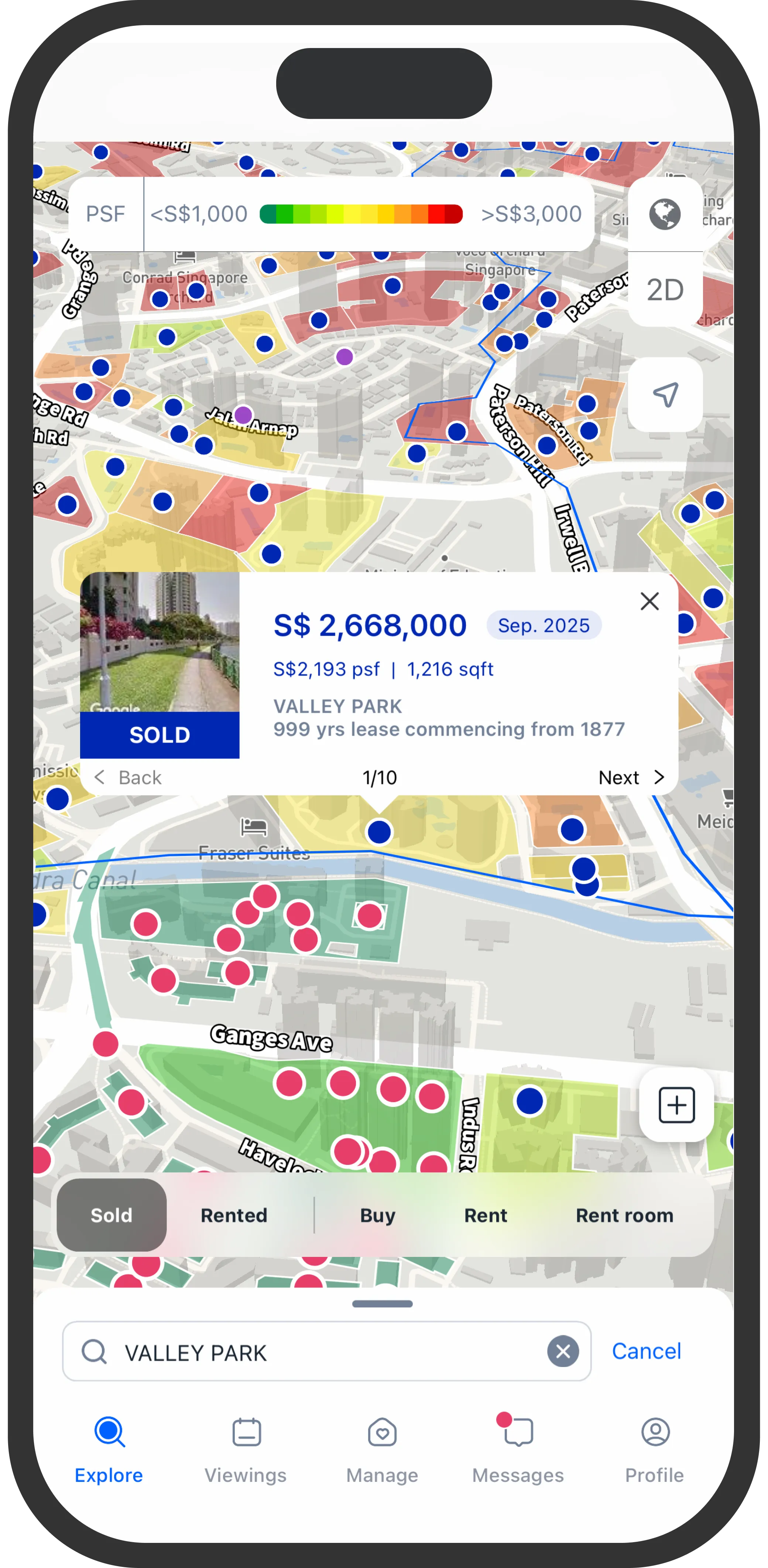
Explore nearby transactions, property data and your surrounding market with Kucing, Singapore’s real estate co-pilot, bringing market intelligence, listings, viewings, offers, chats and favourites together within one Unified PropSpace.
From price insights to viewings and offers, Kucing helps owners, agents, buyers, and tenants move through property decisions with more clarity and control.

.png)