After Your HDB MOP: The 2026–2027 Guide to Selling, Renting, Staying or Upgrading
Your HDB has reached MOP. Should you sell, rent, stay or upgrade? Compare the latest 2026 rules, resale trends, CPF refunds, ABSD costs and practical options before deciding.
Your HDB flat has finally reached its Minimum Occupation Period. The countdown is over. The options are open.
But this is where the decision becomes harder, not easier.
Should we sell while the flat is still relatively new? Rent it out for monthly income? Stay and avoid upgrading costs? Or keep the HDB while purchasing a private property?
The right answer depends on far more than the latest million-dollar resale headline. It depends on the flat’s classification, location, realistic market value, outstanding loan, CPF refund, family plans and the cost of whatever comes next.
The MOP is the minimum period during which an HDB owner must physically occupy the flat before being allowed to sell it, rent out the whole unit or acquire another residential property, subject to the applicable rules.
For most existing BTO owners whose flats were launched before the new classification framework took effect, the MOP is five years. The period generally begins from the date the keys are collected and excludes stretches when the owner did not physically occupy the flat.
Once the MOP is fulfilled, we may generally consider:
selling the flat on the resale market;
renting out the whole flat, where permitted;
buying another HDB flat;
purchasing private residential property;
or remaining in the current home.
Reaching MOP does not mean that selling is automatically the best financial move. It simply means the decision door has opened.
Does the Standard, Plus or Prime framework apply?
Singapore’s Standard, Plus and Prime classification framework began with the October 2024 BTO exercise. It does not retroactively convert most flats reaching MOP in 2026 into Plus or Prime flats.
Standard flats carry a five-year MOP. Plus and Prime flats carry a ten-year MOP, tighter resale eligibility conditions and subsidy recovery when they are sold. Owners of Plus and Prime flats are also not permitted to rent out the whole flat, even after completing the MOP.
This means most owners reaching MOP today are still dealing with the earlier five-year framework. However, anyone buying a future resale Plus or Prime flat should understand that the ten-year MOP and tighter conditions also apply to subsequent owners.
The distinction matters because “wait until MOP, then rent or sell” is no longer a universal HDB strategy.
What the 2026 HDB resale market is telling us
The HDB resale market is no longer rising evenly.
HDB resale prices fell by 0.1% in the first quarter of 2026, the first quarterly decline in almost seven years. The moderation follows several quarters of slower or flat price growth. Meanwhile, around 13,480 flats are expected to reach MOP in 2026, compared with 6,973 in 2025. MOP supply is projected to climb further to 18,939 flats in 2027 and 21,393 in 2028.
More newly eligible resale flats give buyers additional choice. At the same time, HDB continues to increase the supply of new flats. The June 2026 exercise alone offered 6,952 BTO flats across seven projects, including Standard, Plus and Prime developments.
Yet the market remains highly selective. Newer flats with long remaining leases, strong transport links, desirable floor levels and attractive locations can still achieve exceptional prices.
A four-room flat at Bedok South Horizon, for example, sold for S$1.12 million shortly after the project reached MOP, setting a four-room resale record for Bedok. The unit benefited from its relatively young lease, proximity to the future Bedok South MRT station, nearby schools and the wider Bayshore transformation.
The lesson is simple:
The national index may be cooling, but the strongest newly MOP flats are still playing a different game.
We should compare our own block, floor, orientation and nearby transactions rather than using a record sale several estates away as the benchmark.
Option A: Stay and improve the current home
Staying is often dismissed as the passive option. It can also be the most financially efficient.
If the flat still fits our family, commute and lifestyle, staying avoids agent commissions, legal fees, moving costs, renovation expenses and higher monthly repayments. A carefully planned renovation may cost far less than upgrading to a larger or private property.
Staying may make sense when:
the current location remains convenient;
the home has enough space for the next five years;
upgrading would stretch monthly cash flow;
nearby replacement properties offer poor value;
or we prefer to build savings before making a larger move.
The key comparison is not simply the current flat versus a dream home. It is the current flat plus renovation costs versus the full cost of selling, buying, financing and renovating another property.
Option B: Rent out the HDB flat
For eligible owners of five-year-MOP flats, renting out the whole unit may create recurring income while preserving ownership of the property.
But gross rent is not net income.
We should account for:
mortgage payments;
property tax at non-owner-occupier rates;
maintenance and repairs;
agent fees, where applicable;
periods without tenants;
furniture replacement;
insurance;
and the cost of living elsewhere.
Owners must also comply with HDB’s rental registration, tenant eligibility, occupancy and approval requirements. Plus and Prime flats cannot be rented out in full, even after MOP.
Renting may work well when the flat has strong tenant demand and we already have an affordable alternative residence. It becomes less attractive when the expected rental yield is slim after expenses or when purchasing another home creates a heavy tax and financing burden.
Option C: Sell and buy another HDB flat
Selling and moving to another HDB home can be sensible when we need more space, a different location or a property that better supports family plans.
However, the next purchase should be analysed as carefully as the sale.
We should consider:
the selling price of the existing flat;
the remaining housing loan;
CPF principal and accrued interest to be refunded;
resale levy, where applicable;
cash-over-valuation risk on the next flat;
renovation and moving expenses;
and the remaining lease of the replacement property.
Owners buying another subsidised flat may have to pay a resale levy. Buyers considering future Plus or Prime flats should also understand the ten-year MOP and subsidy-recovery conditions.
A larger resale flat may improve daily life without creating the financial leap required for a private-property upgrade. The real question is whether the new home solves a long-term need or simply creates a more expensive version of the same life.
Option D: Sell and upgrade to private property
Selling the HDB before purchasing a private property can simplify the transaction and may prevent a Singapore citizen from being treated as the owner of a second residential property for ABSD purposes.
A Singapore citizen purchasing a second residential property currently faces 20% ABSD, while a third or subsequent property attracts 30%. ABSD is calculated on the higher of the purchase price or market value.
Eligible married couples may qualify for ABSD remission when jointly purchasing a replacement matrimonial home, provided the relevant citizenship, ownership and disposal conditions are met. This should be checked carefully before committing to any purchase sequence.
Upgrading may make sense when:
household income can support higher repayments comfortably;
we have sufficient cash for the downpayment and transaction costs;
the new property supports a long-term family need;
and the decision remains affordable even if interest rates or expenses rise.
It should not be based solely on the belief that private property always appreciates faster.
Option E: Keep the HDB and buy private property
After fulfilling MOP, eligible HDB owners may consider retaining the flat and purchasing private residential property.
This creates two assets, but also two sets of obligations.
The owner may face:
20% ABSD as a Singapore citizen purchasing a second home;
a larger cash and CPF downpayment;
tighter loan-to-value limits;
mortgage stress testing;
higher property taxes;
maintenance expenses across two homes;
and vacancy or tenant risk.
This strategy is usually suitable only for households with strong cash flow, adequate emergency reserves and a clear reason for holding both properties.
Artificial or contrived ownership arrangements designed mainly to avoid stamp duty can attract regulatory scrutiny. Any complex ownership restructuring should be discussed with qualified legal, tax and financing professionals rather than treated as a social-media shortcut.
How much cash will we actually receive?
How much cash will we receive
A high selling price does not equal high cash proceeds.
When an HDB flat is sold, the sale proceeds are generally used in this order:
Repay the outstanding housing loan.
Refund CPF principal used for the property.
Refund the accrued CPF interest.
Pay selling-related costs.
Retain the remaining balance as cash proceeds.
CPF Board states that owners generally need to refund the CPF principal withdrawn and the interest that would have accrued if those savings had remained in the account.
If the flat is sold at market value and the proceeds are insufficient after repaying the housing loan, the owner generally only needs to refund the remaining sale proceeds rather than top up the CPF shortfall in cash.
A simplified estimate is:
Selling price
− outstanding housing loan
− CPF principal and accrued interest
− agent, legal and administrative costs
= estimated cash proceeds
Before listing the flat, we should retrieve the outstanding loan balance and CPF property withdrawal details rather than calculating our future budget from the headline selling price.
The sell, rent or stay scorecard
Question
Stay
Rent
Sell
Does the flat still meet our needs?
Strong reason
Neutral
Strong reason if no
Do we need immediate liquidity?
Weak
Weak
Strong
Is tenant demand strong locally?
Neutral
Strong
Neutral
Can we afford a second property and ABSD?
Neutral
Required if buying another
Less relevant after sale
Are nearby transactions still firm?
Useful
Useful
Critical
Is the replacement home clearly better?
Weak
Neutral
Critical
Do we have enough cash after CPF refund?
Not required
Depends
Critical
Can we tolerate vacancy and repairs?
Not relevant
Critical
Not relevant
The best option is rarely the one with the highest theoretical return. It is the one that remains comfortable under less-than-perfect conditions.
Compare before making the move
Before deciding, we should compare three numbers:
what our flat could realistically sell for;
what it could realistically rent for;
and what the replacement property would cost.
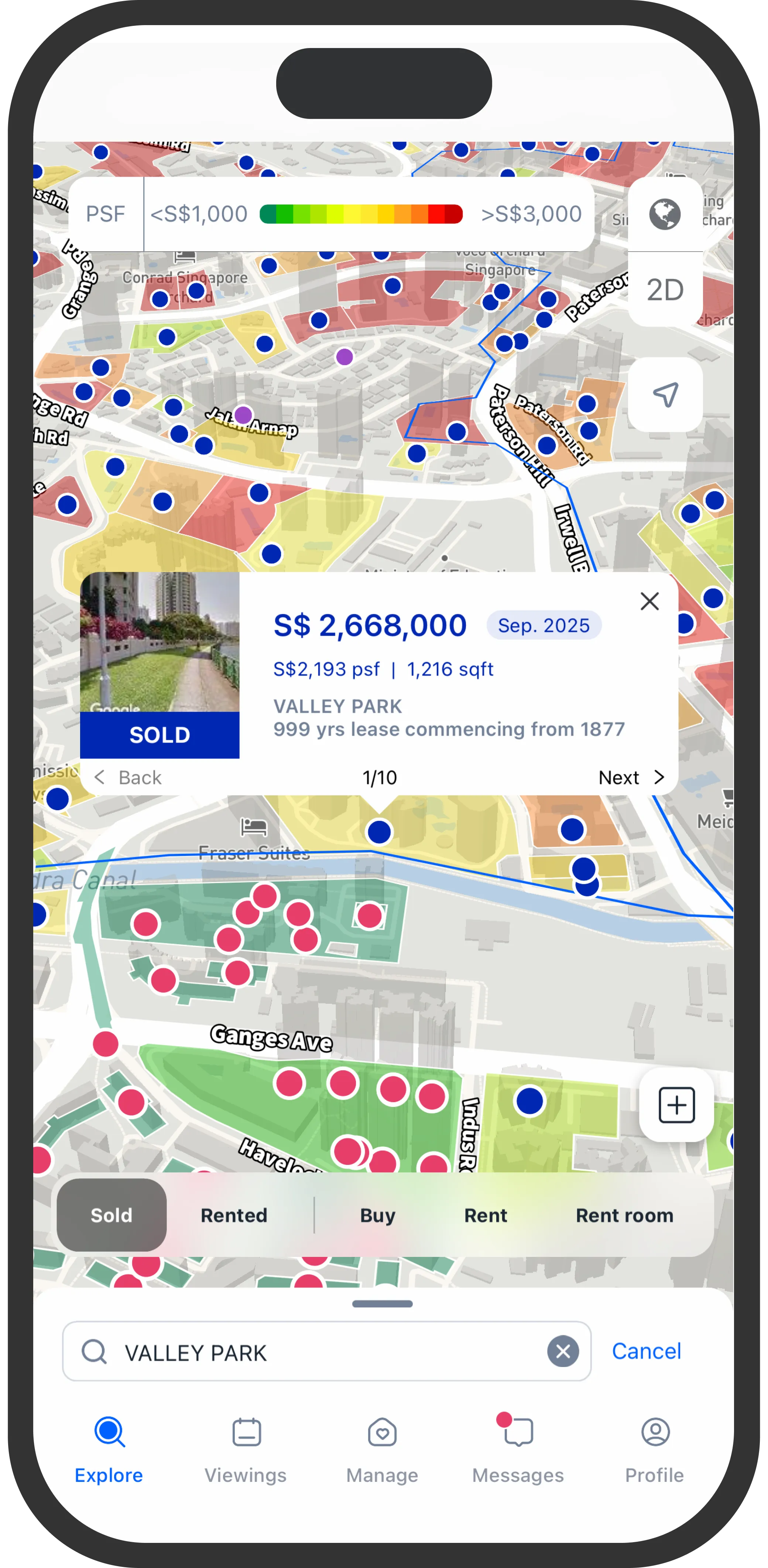
Kucing’s Price Map helps homeowners explore nearby transaction patterns rather than relying only on asking prices or spectacular newspaper sales.
Through Kucing’s Unified PropSpace, owners, buyers and their agents can combine market data, listings, viewings, chats, offers and favourites in one connected dashboard.
Check nearby transactions before deciding whether to sell, rent or stay.
Property, financing, CPF and tax rules depend on individual circumstances. Owners should verify the latest HDB, CPF and IRAS requirements and obtain professional advice where necessary.
From price insights to viewings and offers, Kucing helps owners, agents, buyers, and tenants move through property decisions with more clarity and control.