Should You Buy Property During War Fears in Singapore
War fears are making buyers nervous, but should you really wait? We break down what Singapore property data says in 2026 for HDB, condos, and landed homes.


War fears are making buyers nervous, but should you really wait? We break down what Singapore property data says in 2026 for HDB, condos, and landed homes.
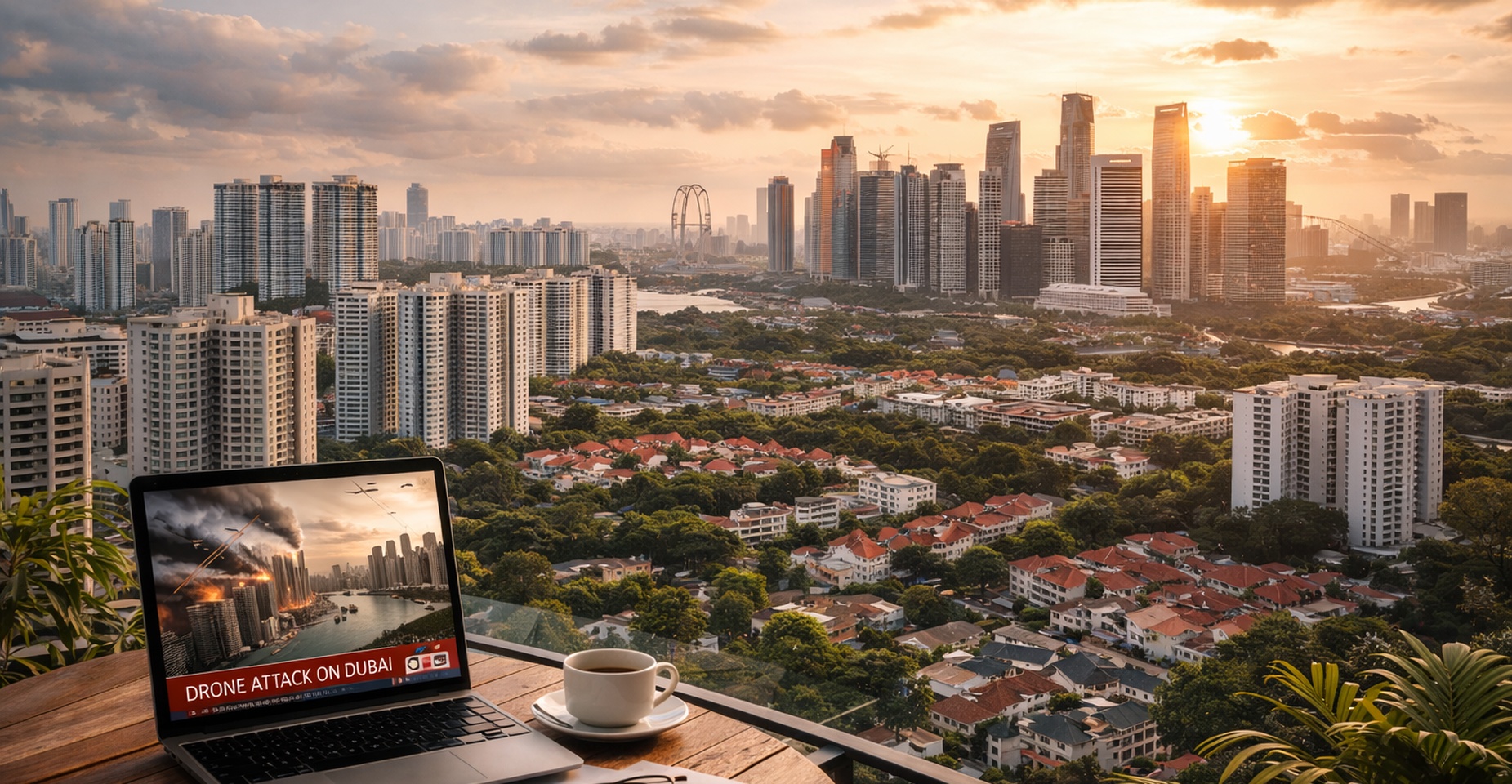
Singaporeans have heard this question before, but in April 2026 it feels less theoretical. Headlines are noisy. Markets are twitchy. People start asking the same thing in different ways: should we delay a purchase, rush into one, downgrade, or just sit tight?
Here is the blunt answer: war fears do not automatically make Singapore property a bad buy. They make bad decisions easier to make. The real danger is not the headline. It is buying the wrong asset, at the wrong price, with the wrong level of financial stress. That matters even more now because Singapore’s market is no longer moving as one simple upward escalator. In 1Q 2026, private home prices still rose, but only by 0.3% quarter on quarter, while HDB resale prices dipped 0.1%, the first quarterly decline in nearly seven years. Transaction patterns also diverged sharply across segments. 
The lazy version of this debate is “Is property safe during war fears?” The sharper version is this: what kind of property, for what purpose, with what holding power? That is the only version worth discussing.
A useful old-school view from Property Soul argued that in an actual wartime scenario, leveraged property owners could still be stuck with mortgage obligations, while war-related damage is commonly excluded from insurance protection. The article also argued that land historically holds up better than buildings in extreme conflict scenarios. That is provocative, but it is also a reminder that buyers should separate emotional comfort from asset structure. 
Singapore’s 1Q 2026 numbers tell a more interesting story than the doom-posts. The private residential price index still rose 0.3%, but this was the smallest quarterly increase in six quarters. Sales volume also fell about 40% quarter on quarter, from 6,699 to 4,041 transactions up to mid-March. In plain English: the market did not collapse, but buyers became more selective. 
Under the hood, the market split. Non-landed private homes rose 1.0% quarter on quarter, with the Outside Central Region up 1.3%. Landed homes moved the other way, falling 1.8% after rising 3.4% in the previous quarter. At the same time, HDB’s flash estimate showed the resale price index at 203.4, down 0.1% from 4Q 2025, while resale volume stood at 6,179 transactions as of 30 March 2026. This is not panic. It is a market that is starting to price risk differently by segment. 
Condos are still the most flexible option for many buyers who want decent liquidity, strong rental relevance, and access to districts where demand remains active. That helps in uncertain times. But flexibility is not immunity. If you overpay for a new launch or stretch your loan too hard, “premium lifestyle asset” can become “very expensive anxiety machine” quite fast. The latest numbers suggest non-landed homes still have momentum, but not blind momentum. 
HDB looks steadier for owner-occupiers who care more about affordability and utility than headline prestige. The small 1Q 2026 dip does not mean HDB is weak. It means the segment may be entering a more balanced phase after a long run-up. For practical households, that can be good news. Less frenzy usually means better negotiating conditions and fewer FOMO mistakes. 
Landed still carries the strongest emotional pull in Singapore property. Bigger space. Scarcity. Status. But in periods of geopolitical anxiety, landed is also the segment where ticket size, financing pressure, and liquidity risk become more visible. The 1.8% quarter-on-quarter price decline in 1Q 2026 is not a disaster. It is a warning that bigger assets can turn less nimble when buyers become cautious. 
Buy now if you are buying for use first, not drama first. That means you have stable income, a cash buffer, and a property you can hold through noise without needing a miracle exit.
Buy now if you find one of these:
That last point matters more than macro theatre. Even URA noted on 1 April 2026 that the macroeconomic outlook has become more uncertain and households should remain prudent when buying property and taking mortgage loans. 
Wait if your purchase depends on heroic assumptions. Wait if you need every rate cut, every bonus, and every future pay raise to survive the mortgage. Wait if you are buying landed mainly because you are afraid everything will be more expensive later. That is not conviction. That is panic wearing loafers.
There is also a supply story worth respecting. URA said the government will continue a high level of private housing supply, with 4,575 private residential units on the Confirmed List in 1H 2026 and about 57,000 units in the overall supply pipeline including ECs. More supply does not guarantee lower prices everywhere, but it does reduce the case for impulsive buying. 
Use this instead of doomscrolling:
The smartest buyers in a fear cycle are rarely the loudest. They are the ones who compare properly, negotiate without fantasy, and choose a property they can live with financially and emotionally.
That is exactly where a data-first platform helps. Kucing’s Unified PropSpace lets you see the market, compare listings, and manage the moving parts of a search in one place instead of guessing from scattered tabs. In a market like this, clarity is not a luxury. It is the edge.
From price insights to viewings and offers, Kucing helps owners, agents, buyers, and tenants move through property decisions with more clarity and control.