Home Insurance Singapore 2027: What HDB and Condo Fire Insurance Does Not Cove
HDB fire insurance and condo MCST cover may not protect everything inside your home. See what Singapore owners, landlords and tenants should check in 2027.

HDB fire insurance and condo MCST cover may not protect everything inside your home. See what Singapore owners, landlords and tenants should check in 2027.

At about 3.55am on 16 August 2026, a fire broke out in a third-floor HDB flat at Block 339 Jurong East Avenue 1. A 67-year-old man was found unresponsive and pronounced dead at the scene, while about 50 residents were evacuated from the block as a precaution.
The fire involved items in the living room. Its cause remains under investigation.
The incident followed several other fatal residential fires in a short period, including fires at Circuit Road on 28 July, Clementi Avenue 4 three days later, and Race Course Road on 5 August.
A cluster of incidents does not by itself prove that residential fires are suddenly becoming more common. But it is a reminder of how quickly a fire inside one home can affect an entire building.
Once the immediate emergency is over, another question can arise:
What will your insurance actually pay for?
Many Singapore homes already have some form of fire or building insurance. That does not necessarily mean the renovations, furniture, electronics and personal belongings inside the home are protected.
This guide explains what HDB fire insurance and condo building insurance do, where the potential gaps are, and what homeowners, landlords and tenants should check before assuming they are fully covered.
The words fire insurance, home insurance, building insurance and mortgage insurance are sometimes used as though they mean the same thing.
They do not.
A building policy may pay to repair or reinstate parts of the physical property without paying for everything you own inside it.
A separate home insurance policy may extend protection to renovations, household contents, personal belongings, temporary accommodation or personal liability, depending on its wording and limits.
For an HDB owner, the distinction is particularly clear. HDB states that its Fire Insurance Scheme covers damaged internal structures, fixtures and areas built and provided by HDB, but does not cover furniture, renovations or personal belongings. HDB therefore encourages owners to consider additional home insurance if they want wider protection.
That difference can become expensive after a serious loss.
A home may contain renovated kitchen cabinetry, built-in storage, appliances, televisions, computers, furniture, clothing and personal possessions accumulated over many years.
The shell of the property is only part of what would have to be replaced.
The latest complete annual figures available from the Singapore Civil Defence Force are for 2025.
SCDF responded to 2,050 fire calls in 2025, up 3% from 2024. Of these, 1,051 involved residential premises, an increase of 8.6% from 968 cases in 2024.
There were also 94 fire injuries requiring hospital admission and six fire fatalities across all fire incidents in 2025.
Residential fires represented 51.3% of all fire calls.
The leading causes were:
Unattended cooking and electrical fires alone accounted for almost six in ten residential fires.
There is an important piece of context, however.
Despite the increase between 2024 and 2025, SCDF noted that the number of residential fires relative to Singapore's total stock of residential dwelling units remained broadly stable over the longer term. The rate was approximately 0.067% in 2021 and 0.065% in 2025.
So the sensible takeaway is not that every Singapore home is suddenly at high risk.
It is that residential fires remain a recurring risk, and the financial consequences can be significant enough to justify understanding exactly what is insured.
The HDB Fire Insurance Scheme is primarily designed to help reinstate the basic flat after fire damage.
According to HDB, it covers the cost of reinstating:
It specifically does not cover home contents such as furniture, renovations and personal belongings.
This distinction matters.
If an HDB flat has undergone substantial renovation, the cost of restoring the household to its pre-fire condition can extend far beyond restoring the original HDB structure.
Items potentially requiring separate protection can include renovated cabinetry, built-in wardrobes, flooring, appliances, furniture, electronics and personal possessions.
HDB owners should therefore think of HDB fire insurance as basic structural protection, rather than a comprehensive policy for everything associated with the home.
Flat owners with HDB housing loans commencing on or after 1 September 1994 must buy and renew HDB fire insurance every five years while they have an outstanding HDB loan.
The current HDB-appointed insurer is Etiqa, with the present insurance period structure running from 16 August 2024 to 15 August 2029.
Owners without an HDB housing loan are still encouraged by HDB to consider appropriate fire and home insurance.
Another common source of confusion is the Home Protection Scheme (HPS).
HPS is not home contents insurance.
It is a mortgage-reducing insurance scheme administered by CPF. It is designed to help settle an insured person's outstanding housing loan if that person dies or becomes permanently incapacitated, subject to the scheme's conditions and insured share.
So these products solve very different problems:
HDB Fire Insurance helps reinstate specified parts of the physical flat after fire damage.
Home Protection Scheme protects against losing the home because the housing loan cannot be serviced following death or permanent incapacity.
Home insurance can provide additional protection for things such as renovations (kitchen cabinets, custom wardrobe, parquet or marble flooring..), contents (appliances, sofas, beds, furnitures..)and other risks, depending on the policy.
Having one does not automatically mean you have the others.
For condominium owners, the picture is slightly more complicated.
It is often said that an MCST's insurance covers only the common areas while everything inside the unit is the owner's responsibility.
That is too simplistic.
Under Singapore's Building (Strata Management) Act 2004, an MCST generally has to insure the subdivided building under a damage policy. The statutory definition of the subdivided building can include certain improvements and fixtures belonging to subsidiary proprietors when they form part of the building.
At the same time, the legislation distinguishes these from items such as paint, wallpaper, temporary wall, floor and ceiling coverings, and removable fixtures.
This means condo insurance is not best understood as a simple line drawn at your front door.
The practical question is:
Where does your MCST policy stop, and where does your personal home insurance need to begin?
Loose household contents and personal possessions are a different category from the insured building itself. Other needs, such as temporary accommodation or personal liability, may also require separate cover.
Condo owners should therefore ask their managing agent or MCST for information about the building's insurance and compare it with their own home policy.
Pay particular attention after a major renovation. Do not assume that either the MCST or your personal policy automatically covers every improvement you have made.
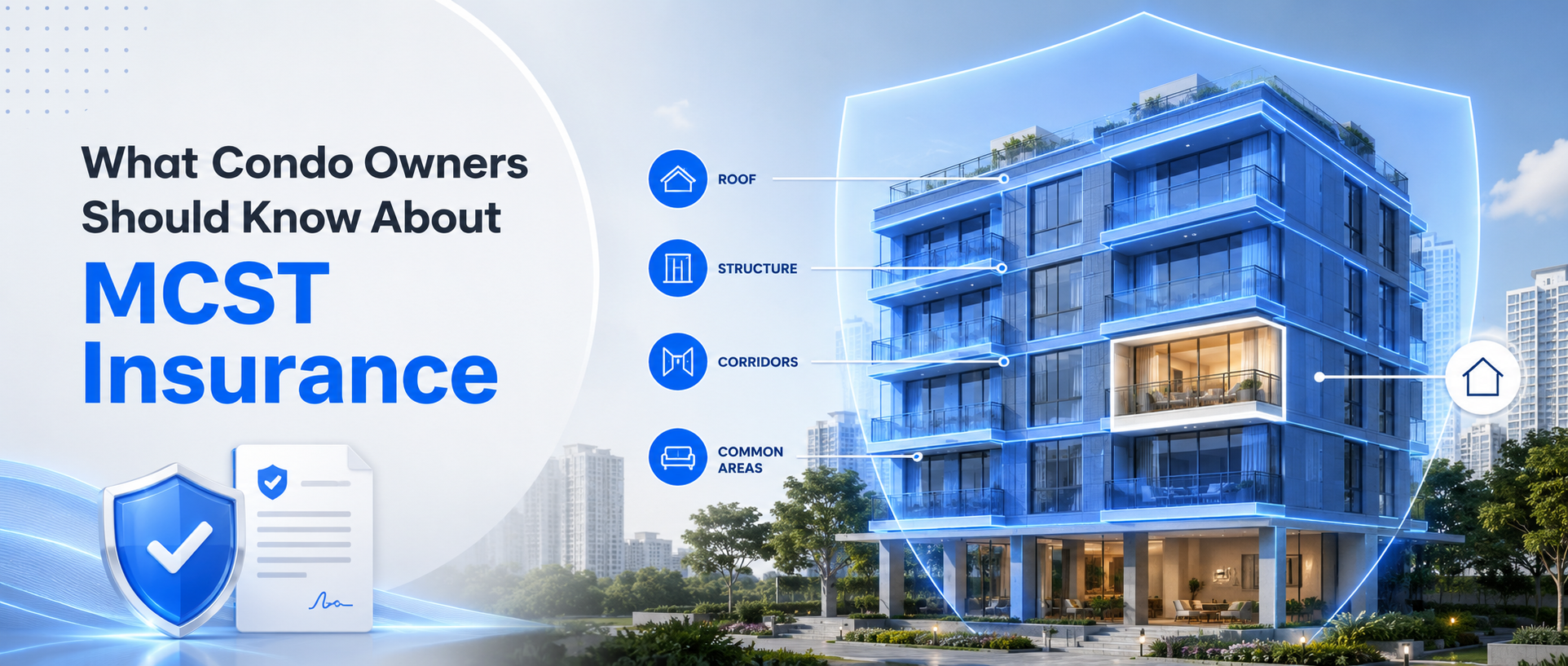
Home insurance is designed to fill some of the gaps left by basic structural or building insurance.
The exact coverage varies by insurer and policy, but HDB itself lists examples of additional home insurance protection such as household items and personal belongings, renovations, alternative accommodation, debris removal and personal liability for damage to a neighbour's property.
Depending on the product, protection may therefore extend to:
These are possible categories of cover, not guarantees.
Two products carrying the label "home insurance" can have different insured events, sub-limits, excesses and exclusions.
The policy wording matters more than the product name.
Electrical fires deserve attention, but they should not overshadow the broader picture.
In 2025, SCDF recorded 304 residential fires of electrical origin. Most were linked to faults in electrical wiring or appliances, or overloaded electrical sockets.
Of those 304 electrical fires, 34 involved Active Mobility Devices (AMDs) in residential premises. That was actually down from 44 in 2024.
So while lithium-ion battery incidents can be severe, unattended cooking and ordinary electrical faults remain major household risks.
It is also important not to attribute every recent residential fire to batteries. SCDF has not identified a cause for the 16 August 2026 Jurong East fire, and investigations remain ongoing.
The practical lesson is broader: modern homes contain more electrical equipment and rechargeable devices, while kitchens and ordinary household wiring remain significant sources of fire risk.
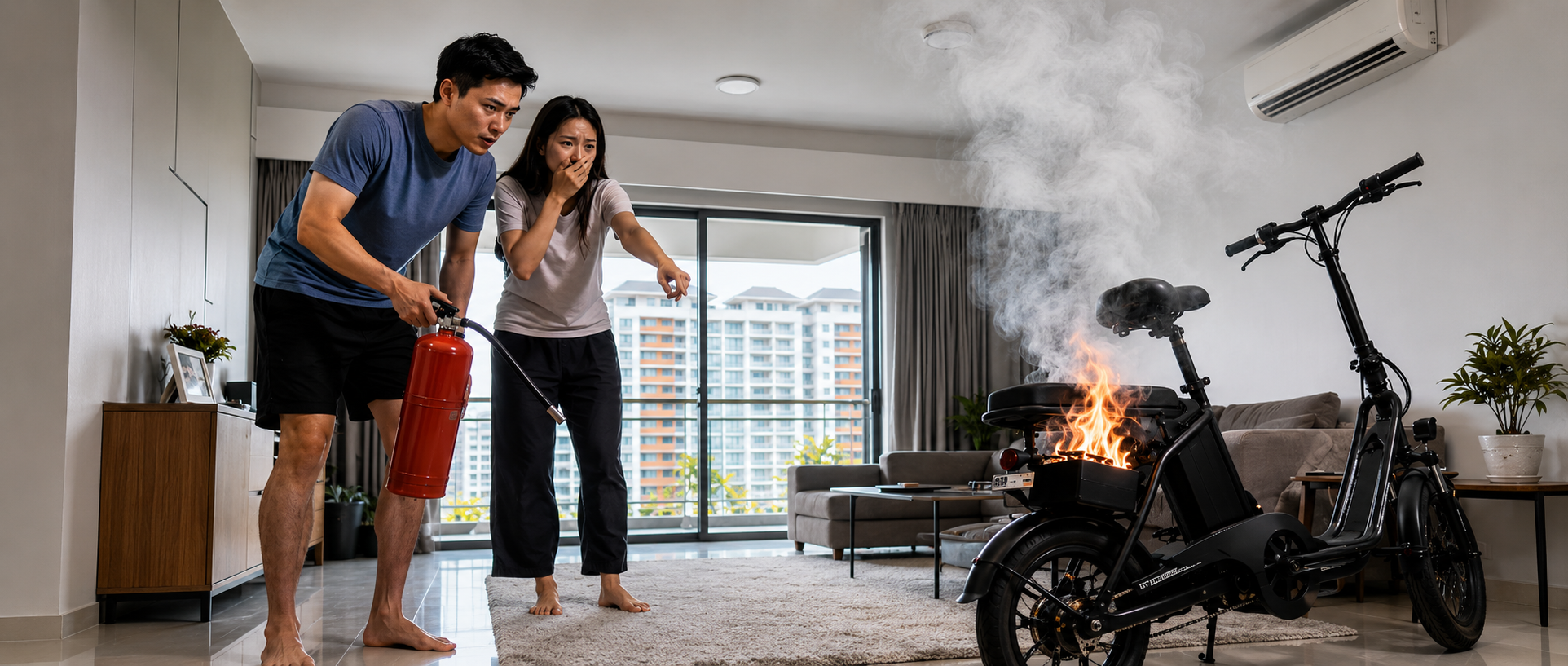
The cost of a fire does not necessarily stop with visibly burnt items.
Smoke can affect rooms away from the source of the fire. Heat can damage fittings and electrical systems. Water used during firefighting can also damage furniture, flooring and other belongings.
Receipts, photographs and a simple room-by-room household inventory should therefore look beyond the obvious and can make future claims easier to substantiate.
Consider the replacement value of your renovations, built-in fittings, furniture, appliances, televisions, computers, phones, home-office equipment, clothing, personal belongings and valuables.
Also consider costs that may arise because you cannot use the home, such as temporary accommodation.
For owners who rent out their property, loss of rental income may be another issue worth checking.
And where a fire, water leak or another insured event affects a neighbouring property, personal liability coverage can become relevant.
The important word is always coverage. Whether any particular loss is insured depends on the policy's insured events, limits, exclusions and conditions.
Receipts, photographs and a simple room-by-room inventory can make future claims easier to substantiate.
An owner-occupier, landlord and tenant can live in the same type of property while having very different financial exposures.
Owner-occupiers may want to consider both the value of renovations and the cost of replacing their family's contents and personal possessions.
A home that was insured when first purchased may also become under-protected after several years of renovation and new purchases.
Landlords should distinguish between the building, their renovations and fittings, furniture supplied with the property, potential loss of rental income and liability exposure.
A partially furnished investment unit and a fully furnished rental unit do not necessarily carry the same risk.
Tenants may own very little of the physical property but still have significant value inside it.
Laptops, electronics, clothing, furniture and personal possessions belonging to a tenant should not automatically be assumed to be covered by the landlord's policy.
Each party should understand what belongs to whom, and whose insurance is intended to protect it.
The market value of a Singapore property is not the same as its insurance replacement value.
A S$1.5 million condo does not necessarily require S$1.5 million of building insurance simply because that was its purchase price. Property prices reflect land value, location, tenure, demand and other market factors.
Insurance sums should instead be assessed according to the basis required by the policy, such as the reinstatement or replacement value of the insured property.
For contents, a useful exercise is to walk through the home room by room and estimate what it would cost to replace everything today, rather than what those items originally cost.
Do the same for renovations.
Kitchen cabinetry, wardrobes, flooring, air-conditioning equipment, electrical work and bathroom renovations can collectively represent a significant amount.
The effect of underinsurance depends on the policy.
Some insurance sections may contain an Average Clause, meaning that if property is insured for less than its required value, a claim can potentially be reduced proportionately.
Other sections may operate on a first-loss basis.
For example, UOI's current UniHome FAQ states that its Average Clause applies to the building structure, while its household contents and renovation sections are on a first-loss basis.
That is a useful illustration of why policy wording matters.
Do not assume the same underinsurance rule applies to every section of a policy, or to every insurer.
Before buying or renewing home insurance, ask these questions:
If any answer is unclear, check the policy wording or ask the insurer.
A reassuring product name is not a substitute for understanding the coverage.
An insurance policy works considerably better when you can show what you owned and what was damaged.
Keep a simple photographic inventory of your home and update it after major purchases or renovations.
Save renovation invoices, furniture receipts, appliance invoices and records for higher-value possessions digitally rather than keeping the only copy inside the property.
If an incident occurs, follow your insurer's claims procedure promptly.
For example, UOI advises home insurance claimants to notify its Claims Division, minimise further loss where reasonably possible, preserve and photograph damaged items, and provide supporting documents such as quotations, receipts and invoices.
Exact requirements vary by insurer, so check your own policy before you need it.
Insurance is financial protection after something goes wrong. Fire prevention remains the first line of defence.
SCDF's 2026 Civil Defence Emergency Handbook advises households not to leave cooking unattended, not to overload electrical outlets, to replace damaged or exposed wiring, and to switch off electrical appliances when they are not being used.
For rechargeable batteries and devices, SCDF advises against leaving them charging unattended for extended periods or overnight, and recommends stopping use if a battery is damaged or deformed.
A Home Fire Alarm Device (HFAD) can provide early warning of a fire.
HFADs are mandatory for new residential premises and for certain existing homes undergoing specified fire-safety works with plans submitted from 1 June 2018. They are not generally mandatory for existing homes that are not undergoing such works, but SCDF strongly encourages homeowners to install them.
SCDF recommends smoke detection for primary home protection and, for a typical single-storey HDB flat or condominium unit, at least one smoke detector positioned along a circulation area or escape route such as the living room or corridor.
Small preventive measures cannot eliminate risk, but they can give occupants something far more valuable than an insurance payout: additional time to react.

Singapore property conversations naturally revolve around price.
How much is the unit worth? What did the neighbour sell for? What is the rental yield? Is the asking price reasonable?
But there is another number worth knowing:
What would it cost to rebuild the parts of your home you are responsible for and replace everything inside it?
At Kucing, we help owners, agents, buyers and tenants navigate property decisions through one digital PropSpace, from market insights and listings to viewings, chats and offers.
Understanding the value of a property is part of that journey. Protecting the value accumulated inside it is another.
If you already have home insurance, this is a good time to review it against your current renovations and possessions rather than the home you had when the policy was first purchased.
If you do not, understand what your existing HDB or MCST protection covers before deciding whether additional protection makes sense.
Click here to get your personalized 'UniHome' Insurance quote from UOI*
*United Overseas Insurance Limited (UOI), a member of the UOB Group and Kucing's insurance partner.
This article is provided for general information only and does not constitute insurance, financial or legal advice. Insurance coverage is subject to the applicable policy terms, conditions, limits and exclusions.
From price insights to viewings and offers, Kucing helps owners, agents, buyers, and tenants move through property decisions with more clarity and control.