Buying Australia Property From Singapore in 2027: Best Cities, New Foreign-Buyer Rules, Taxes & Returns
Thinking of Australian property? Compare Sydney, Melbourne, Brisbane and Perth, plus foreign-buyer rules, taxes, yields, financing and AUD risk.

Thinking of Australian property? Compare Sydney, Melbourne, Brisbane and Perth, plus foreign-buyer rules, taxes, yields, financing and AUD risk.
Australia feels unusually familiar to Singapore investors. Sydney, Melbourne, Perth and Brisbane are hardly exotic names. Many Singaporeans have studied there, travelled there or have family connections there. That familiarity can be dangerous.
Buying Australian property as a Singapore-based investor in 2027 is not simply a matter of choosing a nice suburb and finding a tenant. Foreign-buyer restrictions have tightened, state surcharges can be substantial, financing has become more expensive and Australia's property cycle has shifted noticeably through 2026.
So the question is no longer just “Can Singaporeans buy property in Australia?”
It is: Where does the investment still make sense after taxes, restrictions, financing and currency risk?
Inside this guide [ Updated: Oct. 2026 ]
1. Foreign buyers face a very different market now
2. Sydney vs Melbourne vs Brisbane vs Perth
3. Australia property taxes can change the deal
4. Rental income remains strong, but momentum is cooling
5. Financing and AUD risk matter
6. Australia's housing shortage cuts both ways
7. What Singapore investors should check
The biggest change is also the one investors cannot afford to skim past.
Until 30 June 2029, foreign investors are generally prohibited from purchasing established residential dwellings in Australia, with limited exceptions. Foreign buyers remain able to invest in categories such as new dwellings and qualifying vacant residential land, subject to foreign-investment rules and approval requirements. Residential purchases and disposals must also be notified to Australia's Register of Foreign Ownership of Australian Assets.
Foreign-owned residential property may also trigger an annual vacancy fee if it is not occupied or genuinely available for rent for at least 183 days during the year.
That radically changes the hunt.
A Singapore investor looking at Australia today is increasingly shopping in the new-build market, not browsing established terraces in Melbourne or suburban houses in Sydney.
Australia is not one property market.
Sydney remains the premium liquidity play. But affordability bites. By September 2026, Sydney home prices were about 5.5% below their November 2025 peak and 5% lower year-on-year.
Melbourne is the contrarian bet. Prices were around 5.7% below peak and 5.2% lower year-on-year in September, making it the weakest annual performer among the capitals in the latest PropTrack figures. That weakness is precisely what makes Melbourne interesting: bargain, or value trap?
Brisbane still carries the population and infrastructure story, but momentum has cooled sharply. Prices remained 4.1% above a year earlier in September, even though they had fallen 3.9% from their March peak.
Perth has perhaps the strongest Singapore-investor narrative. Western Australia recorded Australia's fastest state population growth, at 2.1% in the year to March 2026. Perth prices were still 6.7% higher year-on-year in September, despite falling 4.2% from peak.
Adelaide deserves a secondary look for affordability, while Canberra and the Gold Coast can suit narrower strategies. But for Singapore investors, these four cities remain the cleanest starting point.
This is where brochure economics can unravel.
Foreign investors generally face ordinary transfer duty plus an additional foreign-buyer surcharge. The rate differs by state.
NSW's 9% surcharge applies on top of ordinary transfer duty. Revenue NSW illustrates that a foreign purchaser buying a A$1 million property would pay A$90,000 in surcharge purchaser duty, before ordinary transfer duty. Foreign owners can also face 5% surcharge land tax, with no tax-free threshold for that surcharge.
Victoria imposes 8% foreign purchaser additional duty and a 4% absentee-owner surcharge on qualifying taxable land. Queensland imposes 8% additional foreign acquirer duty, while qualifying absentee individuals face a 3% land-tax surcharge above the A$350,000 taxable-land threshold. Western Australia's foreign buyer surcharge is 7%.
And federal costs sit above that state layer: foreign-investment application fees, possible vacancy fees and eventual Australian tax implications on disposal.
At sale, foreign-resident capital-gains withholding is currently 15%, with no minimum property-value threshold from 1 January 2025. That is withholding, not necessarily the final tax liability, but it affects cash flow on exit.
The advertised property price is only the opening bid in the cost stack.
Australian rents remain high.
In September 2026, Domain reported median weekly unit rents of approximately:
Vacancy rates were 1.2% in Sydney, 1.4% in Melbourne, 0.7% in Brisbane and just 0.4% in Perth.
That makes Perth particularly eye-catching. Its unit rents rose 7.7% year-on-year while supply remained exceptionally tight. But rents were flat in the September quarter across Melbourne, Brisbane and Perth.
That matters.
A tight vacancy rate does not mean tenants can absorb unlimited rent increases. Affordability is beginning to put a lid on rental growth.
Investors therefore need to model net yield, not simply annualise the advertised weekly rent..
Australian borrowing conditions have become less friendly.
The Reserve Bank of Australia raised the cash rate to 4.60% in September 2026, explicitly citing persistent inflation pressures. Higher rates have already reduced borrowing capacity and helped push national housing prices below their March peak.
Foreign and non-resident buyers also face a narrower lender universe than Australian residents. Loan-to-value limits, documentation requirements and interest rates can differ materially by lender. Then there is the currency layer.
A Singapore investor effectively owns two assets:
The Australian property + an AUD exposure.
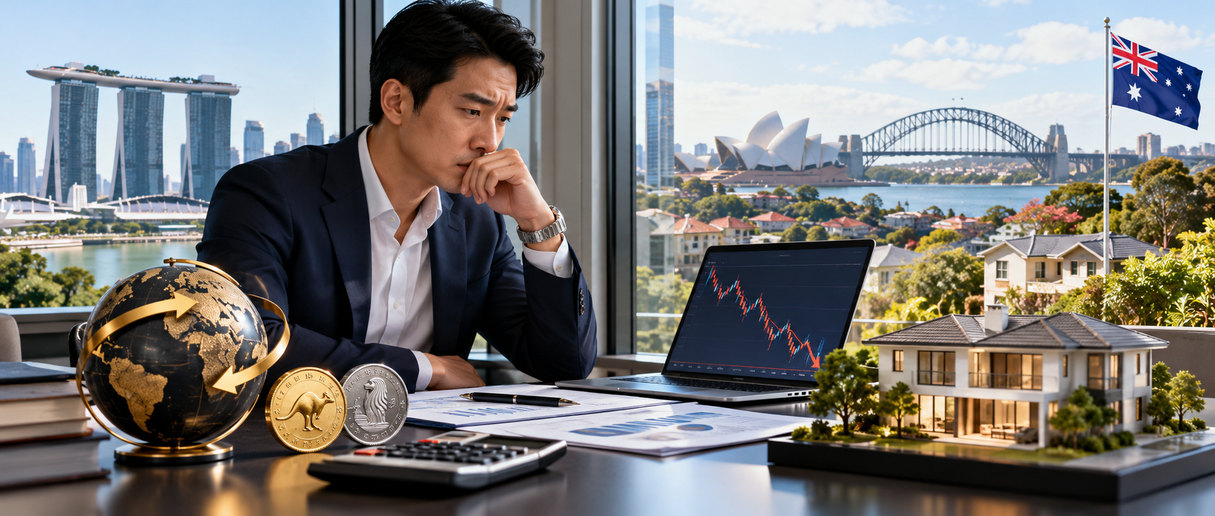
A 6% gain in Australian dollars can become a far smaller SGD return if AUD weakens. Currency movement can also work in your favour, but it should be modelled rather than treated as background noise.
Australia continues to face structural housing undersupply relative to population growth, which supports the long-term rental thesis. PropTrack still identifies constrained housing supply as one factor limiting the severity of the current downturn.
But here lies the paradox.
The same housing shortage supporting rents is also driving political pressure against foreign ownership.
That is why the established-home restriction has been extended through June 2029.
Investors should therefore view Australian housing policy as part of the investment risk, not merely paperwork at settlement.
Before signing any agreement, Singapore-based investors should assess the following 13 considerations. A thorough review goes beyond the purchase price, covering regulatory compliance, ownership costs, financing, investment performance and exit strategy.
And one final comparison matters.
Before sending AUD 1 million overseas because Australian property “Looks cheaper than Singapore”, compare what the equivalent capital buys at home.
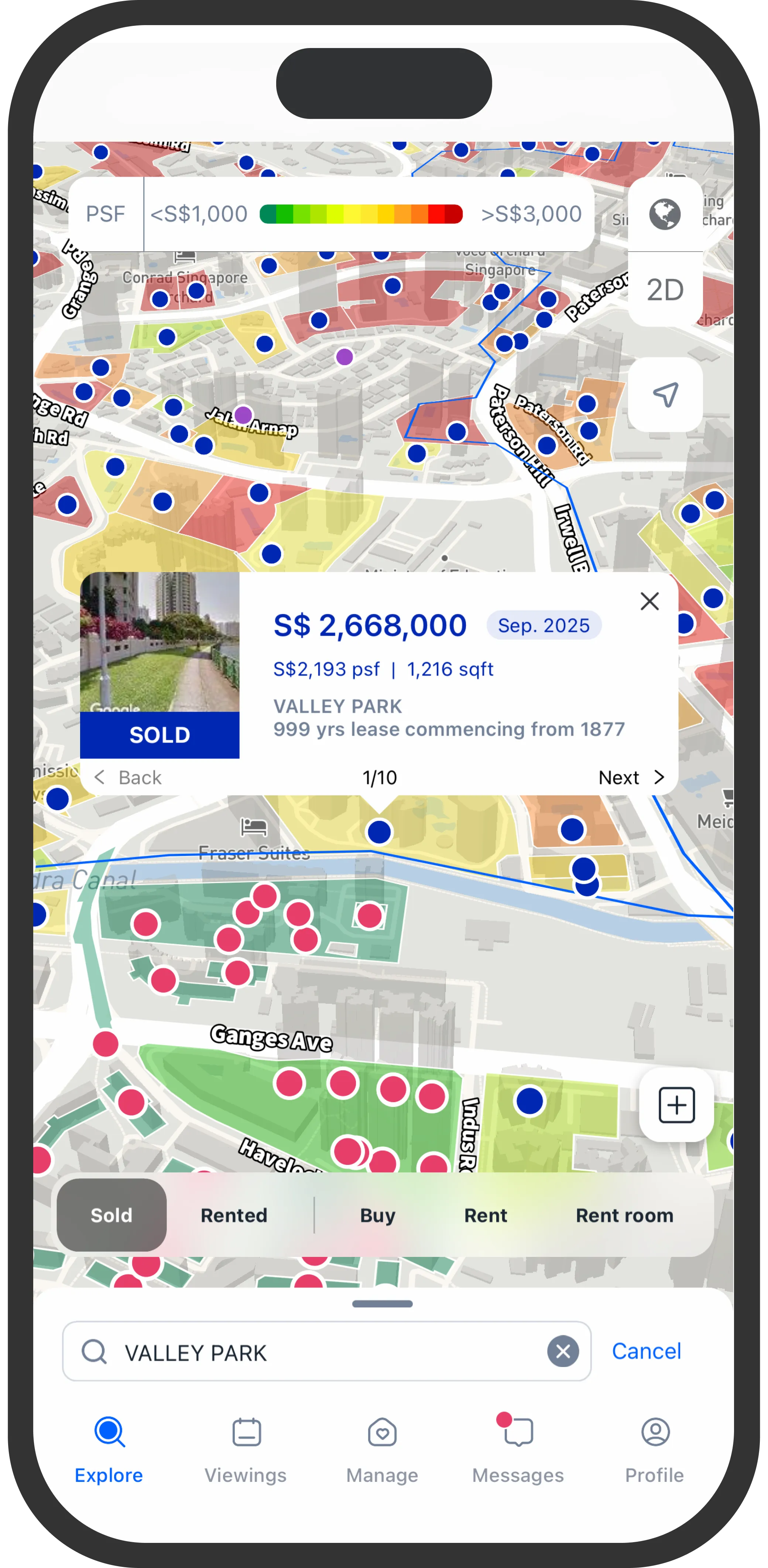
Kucing's Price Map lets buyers explore actual Singapore transaction prices and neighbourhood trends before deciding whether the better risk-adjusted property opportunity is in Perth, Melbourne, Brisbane, Sydney or closer to home.
Disclaimer: This article provides general information, not legal, tax or financial advice. Figures are illustrative and based on rules applicable in October 2026. Obtain professional advice before undertaking any ownership transfer.
From price insights to viewings and offers, Kucing helps owners, agents, buyers, and tenants move through property decisions with more clarity and control.