Coliving Singapore 2027: Smart Living or Flatsharing at a Premium, and What’s Coming Next?
Is Singapore’s booming coliving sector truly the future of smart living, or just flatsharing with a premium price tag? Do traditional room rentals still offer better value ?
Coliving Singapore 2027: Smart Living or Flat sharing at a Premium, and What’s Coming Next?
Coliving Singapore is no longer a niche experiment. The sector is attracting institutional capital, listed operators and new entrants from adjacent industries. For renters, however, one question matters more than the market hype: what is really at stake and are we actually paying extra for?
Coliving can be convenient, flexible and well managed. But it is not automatically the ultimate rental solution. Traditional room rentals and flat sharing have existed for decades and can still offer more control,more space and better value.
Co-living's real opportunity may not be replacing traditional renting. It is filling the space between short-stay accommodation and a conventional home lease.
Singapore's rental rules create very different markets. Private residential homes generally require a minimum three-month stay, while HDB rentals require at least six months. Hotels and serviced apartments cater more easily to shorter stays. That leaves a sizeable group looking for somewhere to live for roughly three months to two years without necessarily wanting a traditional lease, furniture setup and utility contracts.
Co-living serves part of that market. Increasingly, however, it is not the only answer.
Singapore’s coliving sector has matured into an estimated S$1.4 billion investment market. Coliwoo and The Assembly Place have both reached Singapore's public markets, while institutional investors are increasingly entering the asset class. Research cited by Hotel Investment Today found that 65% of investors now view the sector as stable rather than speculative.
A significant milestone came in August 2026, when CapitaLand Ascott Trust agreed to acquire the 212-room Coliwoo Midtown at a property value of S$134 million, while retaining Coliwoo as the operator. The deal is another sign that co-living is moving beyond an operator-led niche into an investible real-estate category.
JustCo, best known forflexible workspaces, unveiled JustAt, a new co-living brand due to debut at JustCo Place on Orchard Road in January 2027. The development will include 123 premium serviced apartments accommodating up to 475 guests.
JustAt also points towards another evolution: the merging of flexible work, flexible living, retail and services within one ecosystem. Co-living may increasingly compete not simply on bedrooms, but on the convenience of the entire live-work experience.
Why Demand Keeps Growing
Industry estimates place Singapore's professionally managed co-living stock at around 9,000 to 10,000 rooms. Cushman & Wakefield estimates this is equivalent to roughly 6% of the combined private non-landed and HDB rental stock
Knight Frank estimates potential addressable demand could reach about 45,800 keys by 2028, significantly above forecast supply. That should be treated as an estimate of the potential market, rather than evidence that every additional co-living room will automatically find a tenant.
Co-living is growing quickly, but it remains one part of a much larger rental market.
Students have become a particularly important demand segment. In 2026, operators reported students representing about 45% of Cove residents, around half of Coliwoo's resident base and 58% at Bespoke Habitat by 2025. The Assembly Place's dedicated 426-key Campus property has reported occupancy above 90%.
That doesn't mean every co-living product is student housing. It does show why operators are increasingly designing products around specific communities rather than treating all renters as one homogeneous market.
The market is also being tested under more normal rental conditions. Private residential rents rose only modestly in the first half of 2026 after the much sharper increases of the post-pandemic years. Yet co-living supply and investment have continued to expand. That suggests the model is increasingly being supported by structural demand for flexibility and convenience, rather than rent inflation alone.
Discounted Co-Living for Young Singaporeans
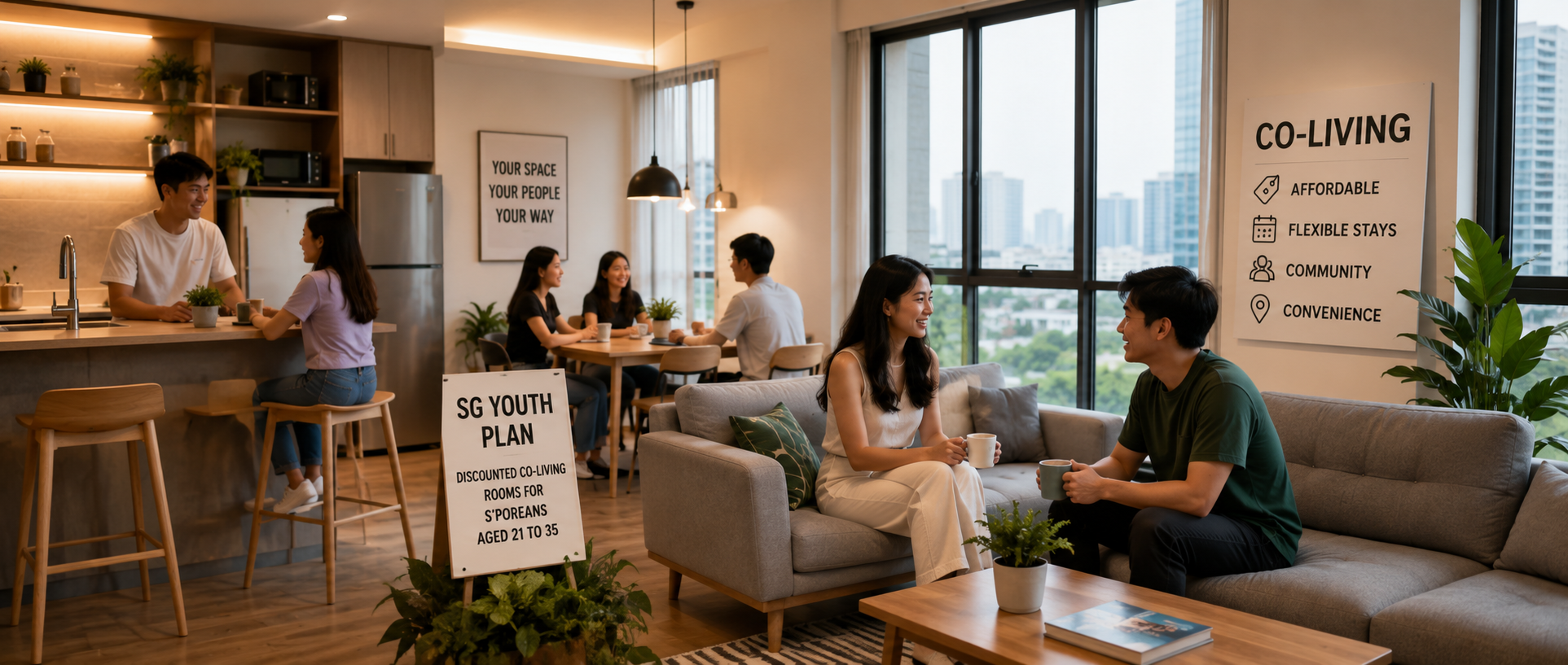
Co-living in Singapore is no longer aimed only at expatriates, students and mobile professionals. Under a new initiative supporting the SG Youth Plan, more than 100 discounted rooms are being offered to Singaporeans aged 21 to 35 who want to experience independent living. This includes singles, couples and those waiting for their Build-To-Order flats.
The participating properties are:
1925 Quarters in Jalan Besar
Coliwoo Boon Lay
Coliwoo Lutheran in Bukit Timah
Prices start from S$1,800 per month, around 30% below the usual rates, with twin and queen-room options available. Applications are offered on a first-come, first-served basis. Coliwoo’s advertised starting rates are S$1,950 at Boon Lay and S$2,000 at Lutheran, excluding utilities.
This initiative adds a new layer to Singapore’s co-living story. It recognises that some young adults want privacy and independence before they are ready, or eligible, to purchase a home. It also positions co-living as a temporary lifestyle experiment rather than a permanent housing solution. Flexible minimum stays allow residents to test independent living without immediately taking on a conventional long-term tenancy.
However, the discount should still be assessed against the full monthly cost. A subsidised room may remain more expensive than renting a room directly from an HDB owner or sharing a conventional apartment with friends. Utilities may be charged separately, and residents should confirm what cleaning, air-conditioning servicing, deposits and administrative fees are included.
The initiative also has a social goal. The 2025 National Youth Survey found that 8% of young respondents reported having no close friends, compared with 4% in 2013. Participating operators are therefore expected to offer communal activities and informal gatherings designed to help residents form connections.
For young Singaporeans, the key question remains unchanged:
Does the convenience, flexibility and community justify the premium after every cost is counted?
Before committing, we should compare the discounted co-living rate with nearby room rentals, transport costs, lease flexibility and the value of included services. A government-supported initiative may improve accessibility, but it does not automatically make co-living the cheapest option.
What Does the Premium Actually Buy ?
The attraction is easy to understand. A furnished room,Wi-Fi, utilities, maintenance and some cleaning may be bundled into one monthly payment. Flexible leases can also be valuable for someone arriving in Singapore with little time to organise a home.
But renters should compare the actual package, not just the headline rent. Are utilities unlimited? Is your bedroom cleaned? Is air-conditioning servicing included? Are there administrative, checkout or repair charges? And how much usable common space are you really sharing ?
The physical product is professionalising too. Hospitality suppliers and interior specialists are increasingly entering the sector, another sign that larger operators are moving beyond simply furnishing spare bedrooms towards more deliberately designed rental products.
All-inclusive Does Not Mean Everything
One Singapore co-living operator, for example, states that utilities are capped at S$80 per room and weekly cleaning covers common areas only. What about reconciliation fees ? Move-out and admin fees ? Those conditions may be perfectly reasonable, but they show why “all-inclusive” deserves a second look. It is also worth asking what happens if the operator defaults or ceases trading, and how securely your deposit is held and recovered.
Traditional flatsharing can involve more coordination, or simply a fixed upfront arrangement, as residents often manage bills and household routines themselves. Yet it can also be more transparent. You may pay the agreed rent, split actual utility costs, and decide together how the home is run
Who Chooses Your Flatmates ?
“Community” sounds attractive. Compatibility is harder.
When rooms are rented individually, residents may have limited influence over who takes the bedroom next door. Working hours, hygiene, visitors, cooking and noise can shape daily life far more than a curated lounge. Do you have a say in House-rules, or are you expected to sign the agreement as is, with no room for amendments?
Professional management does not necessarily solve every human problem either. Cove’s published house rules state that its policy is generally to limit involvement in personal disputes between flatmates and encourage residents to resolve them themselves.
Is it Coliving Or Managed Flatsharing ?
Co-living covers a wide spectrum. At one end are purpose-designed residences with substantial shared amenities and hospitality-style services. At the other, the model can resemble traditional flatsharing managed by a company, with conventional homes operated and rented room by room (= sub-lease)
One important detail: “co-living” is not itself a planning use in Singapore. URA treats it as a marketing term. A co-living property can operate within residential, serviced-apartment or hotel use, and the rules of that underlying property type still apply.
That is another reason tenants should look beyond the branding and understand what kind of accommodation they are actually renting.
So look at the floor plan, not the label. Has living space been converted into extra bedrooms ? How many residents share the bathrooms and kitchen ? Is there still a proper living room? What about unit partitioning and Soundproofing ?
Singapore generally caps private homes at six unrelated occupants. Qualifying properties of at least 90 sqm can temporarily house up to eight, subject to registration, under rules extended until 31 December 2028.
More rentable bedrooms can improve an operator’s economics.They do not automatically improve your quality of life.
Something new is appearing in the middle
Singapore's rental market is also beginning to produce formats that do not fit neatly into either co-living or traditional flatsharing.
House 223 in Geylang, opening in September 2026, illustrates the trend. Its approximately 200 sq ft micro-residences are fully self-contained, including a private bathroom, kitchenette and laundry facilities, while communal areas remain available for residents. Monthly rents are expected to range from about S$2,300 to S$2,700, targeting stays of three to 24 months.
That raises an interesting question. If a tenant gets their own kitchen, bathroom and laundry facilities but still shares social spaces, is that co-living, a micro-apartment, or simply a new form of managed rental?
The next phase may be purpose-built rental housing
Singapore is also experimenting with a new category called Serviced Apartments II, or SA2. Unlike conventional serviced apartments, SA2 is designed specifically for stays of at least three months and allows more flexible layouts, including en-suite rooms and shared living amenities.
That matters because much of today's co-living stock comes from converted shophouses, hotels, landed homes or conventional apartments. SA2 creates a pathway for buildings designed from the beginning around long-term rental rather than retrofitted afterwards.
In other words, tomorrow's competitor to the traditional room rental may not simply be another co-living operator. It could be an entirely new generation of purpose-built rental housing.
For renters, the label matters less than the trade-off between privacy, space, convenience and price.
Beyond Coliving: How Singapore Finds Rooms ?
Co-living operators are only one route into Singapore’s room-rental market.
Traditional room-rental marketplaces, alongside large social-media rental communities, connect owners or their appointed agents with tenants and prospective flatmates. Their continued popularity proves something important: demand for room rentals outside the managed co-living model is not going away anytime soon.
The trade-off is often the search experience. On large social-media communities in particular, users may need to scroll through streams of posts, repeat the same questions, check whether listings remain available and assess the credibility of advertisers themselves. Structured filters, consistent moderation and built-in identity verification can vary significantly between channels.
Traditional marketplaces are also evolving. Some now provide smart filters, verification or safer messaging. But the wider room-rental journey can still feel fragmented: find a listing here, message someone there, arrange a visit elsewhere, then keep track of everything manually.
The answer is not necessarily to turn every spare bedroom into a branded co-living product.
It is to modernise flatsharing itself, with smarter search, better filtering, clearer property information, stronger identity checks and one place to manage conversations, viewings and offers.
Compare Before You Commit
Question
Co-living
Room rental / flatshare
🛏
Furnished
Usually
Varies
🔌
Utilities
Often bundled, capped
Usually shared
🧹
Cleaning
Often common areas only
Self-managed
👥
Flatmate choice
Limited
Greater
📅
Flexibility
Often more flexible, but legal minimum depends on property type
3 months private residential / 6 months HDB
🏠
Living space
Varies widely
Varies widely
🔎
Search experience
Managed by one operator
Depends on platform
🛡
Privacy
From shared facilities to fully self-contained
Usually private bedroom, shared facilities
💰
Price
Convenience premium
More cost-focused
There is no universal winner. Co-living can be excellent for convenience. Direct room rental and flatsharing can be excellent for value, control and choice.
The smarter move is to compare the actual home, total cost, people and living arrangement before committing.
A note on flexibility: Co-living is often promoted as a flexible housing solution, but flexibility does not necessarily mean a short-term stay. There is no published market-wide average length of stay in Singapore, although available industry figures suggest around 6 to 9 months, with some operators reporting averages of up to 14 months. For renters planning to stay for 6 to 12 months or longer, it may therefore be worth comparing the cumulative co-living premium with the cost of a room rental or traditional flatshare.
Find or List a Room in Singapore
Whether you are comparing coliving, searching for a room in an existing flatshare or renting out your own spare bedroom, the goal is the same: better information, better matches and fewer blind spots.
Coliving Singapore is growing, but sharing a home, white goods and facilities is not a new invention. The future may not be co-living versus traditional flatsharing. I t may be a wider spectrum of rental choices.
At one end: conventional rooms and flatshares, offering control and potentially lower cost.
In the middle: professionally managed co-living, combining convenience with shared living.
Further along: self-contained micro-residences and long-stay serviced apartments, offering more privacy at a higher price.
The innovation is not necessarily sharing a kitchen or organising community events. It is creating more housing formats for people whose needs fall somewhere between a hotel room and a conventional home lease.
At Kucing, we do not believe every renter needs the same housing model.
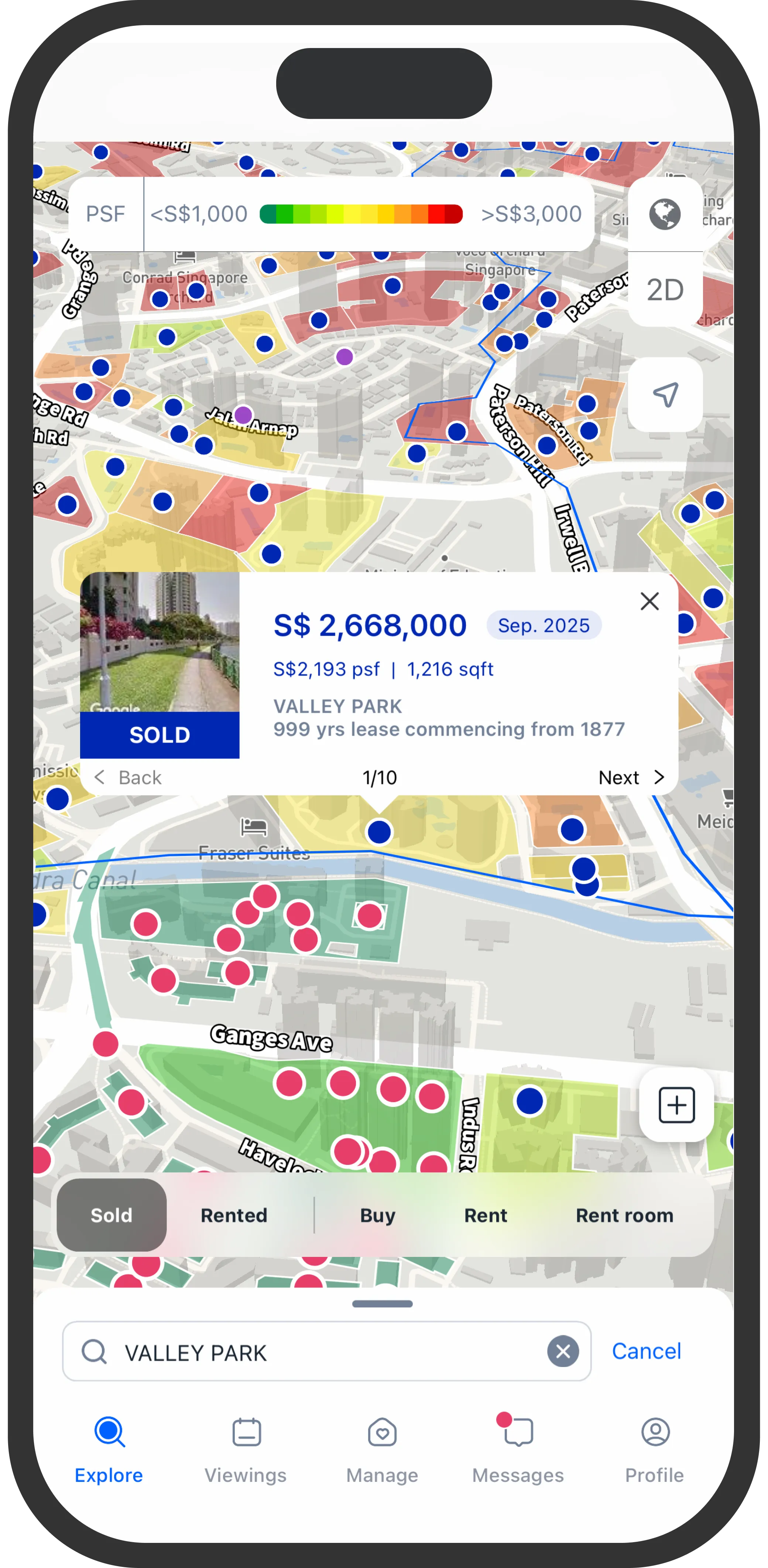
Our Unified PropSpace is designed to bring the fragmented property journey together, from discovery and market information to home-tour bookings, chats, viewings, favourites, managing and making offers. Identity verification, including Singpass-based checks, can also help create greater confidence between users.
Search rental homes. Search rental rooms. Post a unit for rent. Post a room for rent.
From price insights to viewings and offers, Kucing helps owners, agents, buyers, and tenants move through property decisions with more clarity and control.