Landed Property Singapore 2027: Prices, Areas, Rules & Buyer Guide
Explore landed property in Singapore with 5 years of URA data. Compare prices, districts, tenure, zoning, buyer rules, rentals and key checks.

Explore landed property in Singapore with 5 years of URA data. Compare prices, districts, tenure, zoning, buyer rules, rentals and key checks.
Last updated: October 2026
A landed home in Singapore can look deceptively simple: a gate, a driveway, a few storeys and perhaps enough garden to justify owning gardening tools.
But buying landed property in Singapore is fundamentally different from buying a condominium. You are buying THREE things at once:
That third element is where some of the biggest surprises hide.
Two terrace houses can each advertise 2,000 sq ft of land and still be very different propositions. One may have good frontage and straightforward redevelopment potential. Another may have an awkward plot, restrictive setbacks or part of the site affected by a road or drainage reserve.
So before asking how many bedrooms there are, ask something more useful: What exactly am I buying, and what can this plot become?
This guide goes beyond the usual terrace-versus-semi-D-versus-bungalow formula. We will look at where Singapore's landed homes actually trade, five years of URA transaction data, prices, land PSF, tenure, redevelopment, foreign ownership, rental restrictions, shophouses and the things listing photographs rarely show.
1. Landed Property in Singapore in 60 Seconds
2. Where Singapore's Landed Homes Actually Are?
3. The Rule Most Buyers Miss: Not All Land Is Equal
4. Singapore's Landed Market in Numbers
5. Non-Strata Landed: What Buyers Actually Paid
6. Strata Landed Is a Different Price Market
7. How Much Does Landed Property Cost in Singapore?
8. Where Are People Actually Buying?
9. Freehold, 999-Year or 99-Year? The Tenure Split Is Surprisingly Different
10. Who Can Actually Buy Landed Property?
11. Before You Make an Offer: 20 Checks for a Landed Home
12. Renovate, Additions and Alteration, Reconstruct or Rebuild?
13. Buying Landed Property to Rent? Read the Rules First
14. Conservation Homes and Shophouses: A Different Animal
15. The Maintenance Fee You Never Receive a Bill For
16. Landed vs Condo: The S$5 Million Question
17. Landed Property Singapore FAQ
18. Before You Buy the House, Research the Street
First, separate property-market terminology from URA planning categories.
A terrace, semi-detached house and bungalow describe different landed housing forms. URA then applies planning controls including minimum plot dimensions, setbacks and, for some categories, site coverage.
*These are prevailing planning controls relevant to development and redevelopment, not a statement that every existing Singapore property meets today's dimensions. URA's latest landed housing controls were updated in June 2026.
Strata landed also deserves its own box. URA defines it as strata-titled landed units occupying a common development site, normally with communal facilities and shared access.
It may look like conventional landed housing.
Economically and legally, it is not quite the same animal.
URA safeguards specific landed housing areas rather than scattering new landed development freely across Singapore. Its Designated Landed Housing Area Plan identifies the applicable housing form and height controls, with some streets subject to additional Street Block Plans.
For house hunting, broad landed belts include:
But geography becomes much more interesting when transaction activity is added.
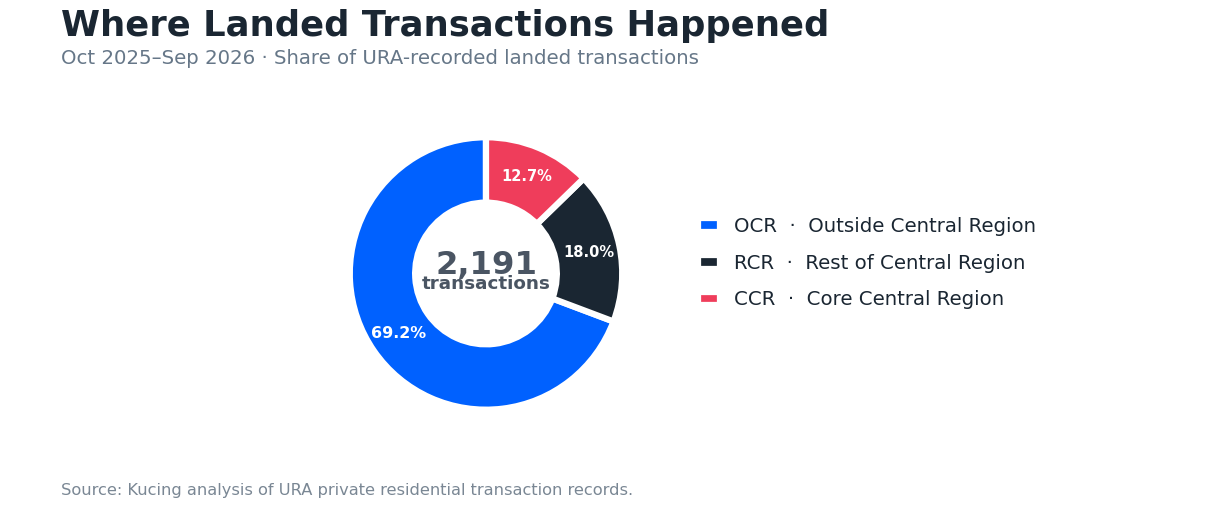
This does not mean Two Third of buyer demand belongs to the OCR. A completed transaction requires both a buyer and a seller. Volume is therefore better interpreted as market turnover or liquidity, rather than pure demand. That distinction matters.
Suppose two listings both say: Land area: 2,000 sq ft.
That does not mean they offer the same usable or redevelopment potential.
Check:
URA's landed envelope controls are based on setbacks and permissible storey height. Landed housing must generally comply with the applicable 2-storey, 3-storey or other prescribed height control. And buyers should not assume that every existing extension or alteration was approved. URA advises purchasers to check approved plans because a new owner can inherit responsibility for unauthorised works.
This is where the landed market becomes much more revealing.
For this article, Kucing analysed 10,119 URA private residential landed transactions covering October 2021 to September 2026:
Remark: Transaction counts should be described as URA-recorded transactions, not the theoretical universe of every private deal completed in Singapore. Because caveat lodgement is not mandatory, so the public database may not contain every transaction.
Interestingly, market turnover has risen 43.6% from the 2022/23 trough, although it remains below the particularly active 2021/22 period.
The composition has changed too. Non-strata landed represented about 80% of transactions in 2021/22, compared with 88.2% in the latest period.
Across the entire five-year dataset:
That makes resale evidence unusually important when researching landed property.
The market is not primarily driven by giant batches of identical new units. Each street slowly produces its own collection of comparables.
Non-strata is where land PSF becomes particularly useful because URA records the area type as Land
For the latest complete 12 months:
One result may initially look odd: Terraces recorded a higher median land PSF than semi-detached houses.
But bigger houses do not automatically command a higher per-square-foot land price. Semi-D plots are materially larger. Location, plot size and transaction mix also influence the median.
This is why comparing landed property solely by total quantum is dangerous
Comparing the first and latest complete periods:
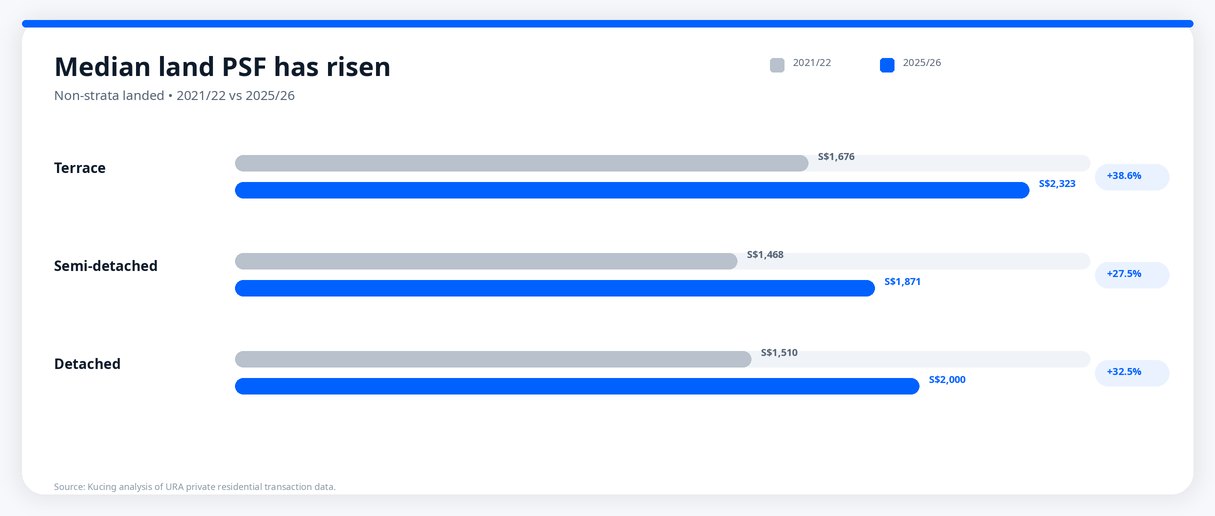
Median transacted prices also moved:
These are changes in transaction medians, not same-property appreciation rates.
The mix of houses sold in each period changes. That caveat is important, especially in landed property where one rebuilt bungalow and one old teardown candidate can barely resemble each other.
Strata landed deserves to be analysed separately rather than mixed casually into conventional landed statistics.
In the latest 12 months:
There is a crucial warning here: Do not compare non-strata land PSF directly with strata landed PSF.
For non-strata transactions, URA's area is the land area. For strata transactions, it is the strata area.
They measure different things. The more useful comparison is total entry quantum.
The answer depends enormously on whether you are buying strata or non-strata landed.
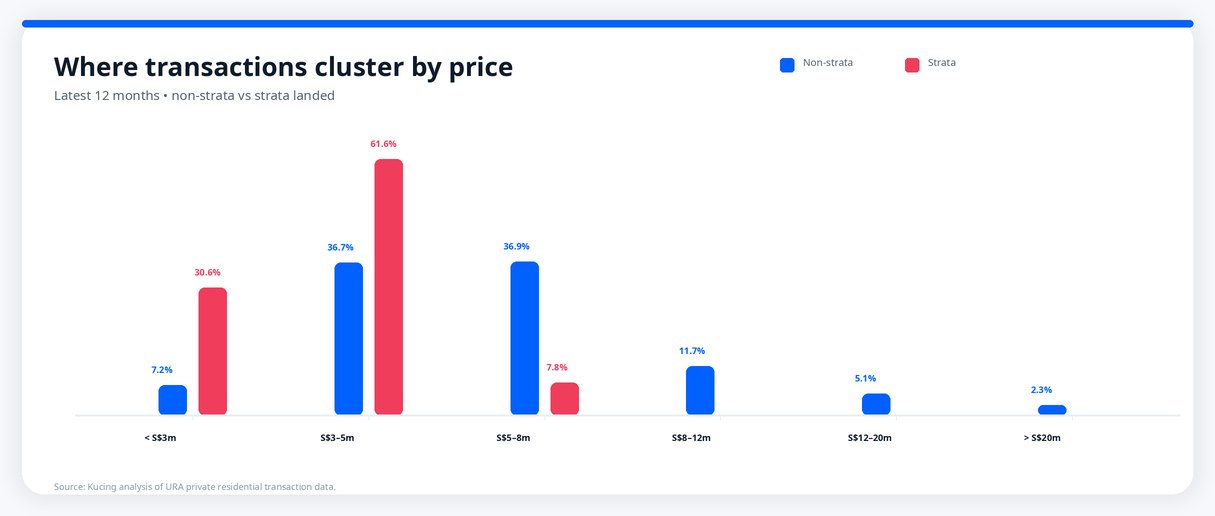
Nearly three-quarters of non-strata transactions fell between S$3m and S$8m.
That makes strata landed a very different entry route into landed-style living.
But there is another number buyers frequently miss: The condition of the house
Consider two hypothetical properties:
House A: S$5m and requires very substantial redevelopment.
House B: S$6m and was recently rebuilt.
House A is not automatically “S$1m cheaper”.
The real comparison is closer to: Purchase price + taxes + immediate repairs + professional fees + renovation/reconstruction + financing + temporary accommodation
Sometimes an old landed house is a bargain. Sometimes you are effectively buying an expensive plot with a roof waiting to be removed.
Looking at transaction activity by postal district reveals another side of the landed market.
The top three districts alone accounted for approximately 40% of all landed transactions in the latest period.
That is more useful than simply saying “landed homes can be found in Bukit Timah and the East”.
D10 and D11 contain some of Singapore's highest-value landed areas. But D19, D15 and D28 generated considerably more transactions.
For a future seller, that distinction matters. A prestigious micro-market may be extremely valuable while still producing few comparable sales.
A larger suburban landed belt can provide a much deeper transaction pool.
Kucing can eventually turn this into something particularly powerful: “Where is landed property most liquid?” , not just where landed houses exist.
Singapore landed property is often associated with freehold ownership.
The URA data largely supports that perception for non-strata landed, but not universally.
Around 83% of non-strata transactions were either freehold or 999-year tenure.
NB: 999-year lease is still a lease. It highlights just how strongly very-long-tenure stock features in conventional landed transactions.
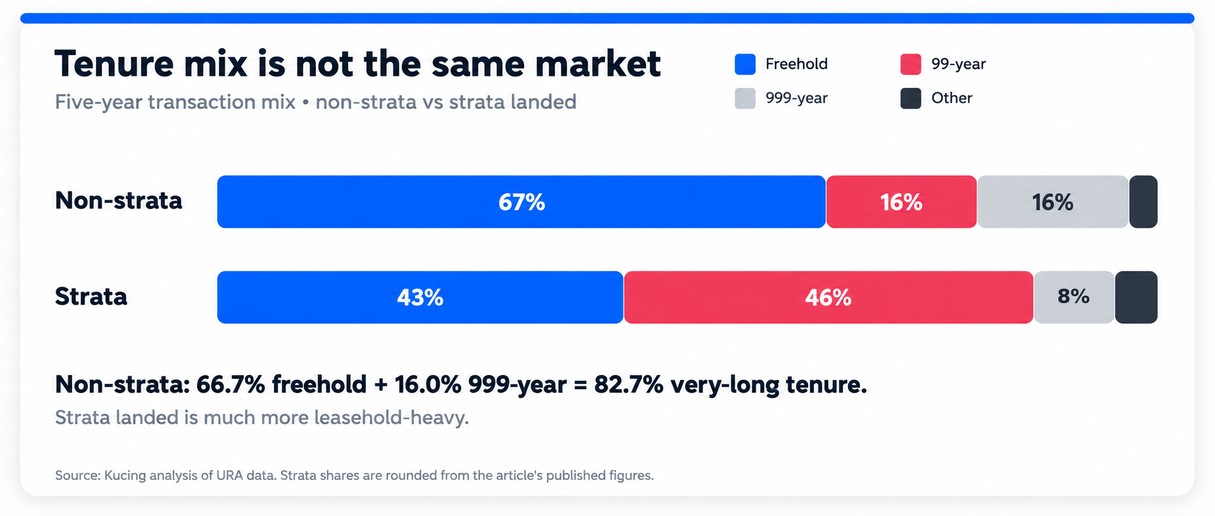
Strata landed looks different : Across its 5-year dataset, about 46% of transactions involved 99-year tenure, while approximately 43% were freehold.
Another reason not to mix the two categories into one convenient “landed” average.
This is one of the biggest differences between conventional landed housing and condominiums.
Singapore Citizens can generally acquire private landed residential property.
Singapore Permanent Residents and other foreign persons face additional restrictions under the Residential Property Act.
SLA states that approval is generally required for foreign persons purchasing:
Land Dealings Approval Unit (LDAU), a division of the Singapore Land Authority (SLA) ,regulates foreign ownership, manages and reviews applications from non-Singapore citizens—including Permanent Residents (PRs) and foreigners—who wish to buy restricted residential properties in Singapore
For foreign persons, foreign entities and Singapore entities keen to purchase /acquire restricted residential property, application is required and assessed individually.
For PR applicants, SLA currently cites criteria including at least five years of Singapore Permanent Residence and exceptional economic contribution to Singapore.
A strata landed house within an approved condominium development is treated differently.
And then there is ABSD. Being allowed to buy the property does not tell you how much buying it will cost.
Treaty provisions and specific remission arrangements can affect individual cases. Eligibility and tax are therefore separate questions.
A beautiful landed house can contain beautifully expensive surprises.
Use this checklist before getting emotionally attached to the staircase.
URA specifically advises property purchasers to verify approved plans and unauthorised works before buying.
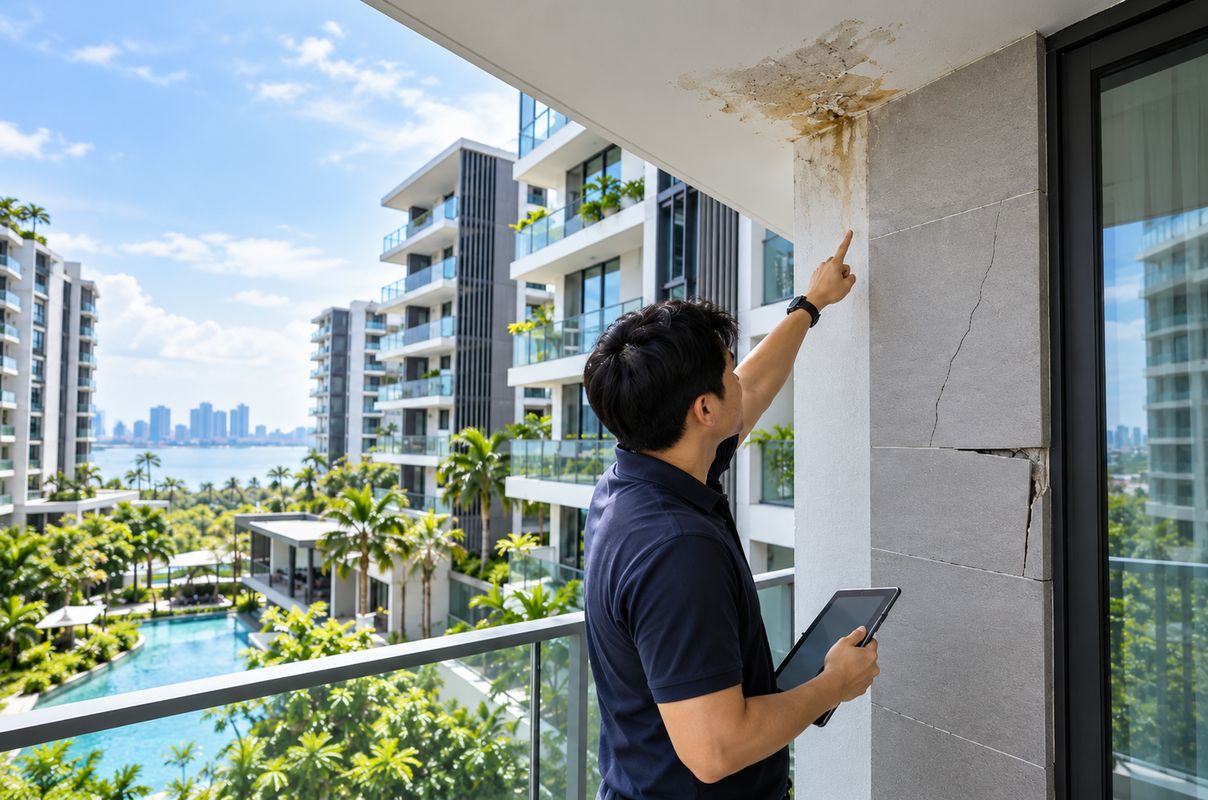
Look up for: Roof condition, guttering, ceiling stains, previous water ingress.
Look down for: Drainage, cracks, inspection chambers, ponding, differences between road and ground level.
Fresh paint is very good at interviewing for the role of “nothing to see here”.
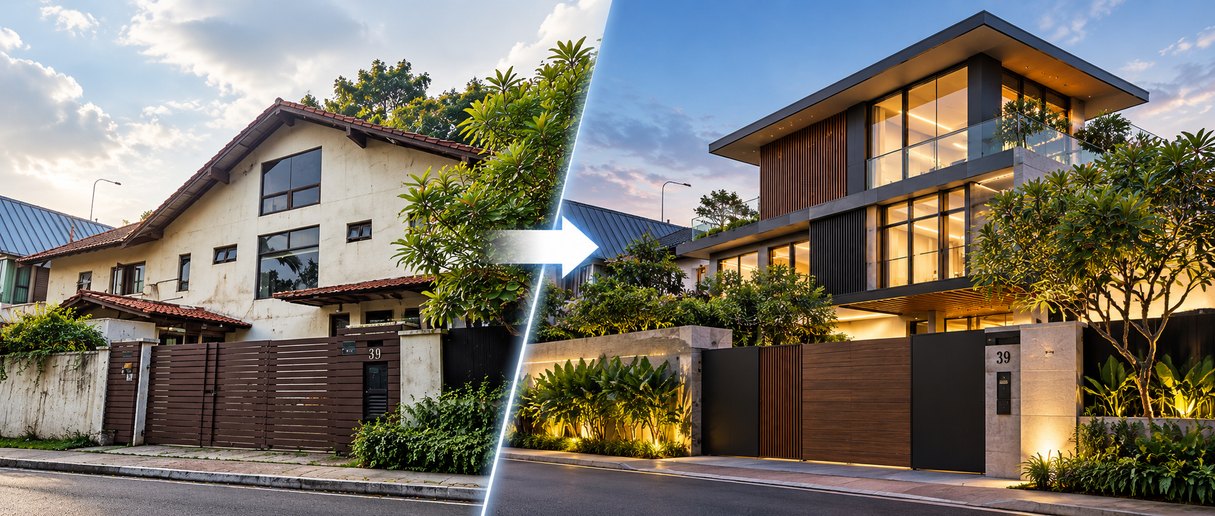
Buying an ageing landed property is partly a property decision and partly a development decision.
There are four very different scenarios:
All landed housing is subject to URA's building envelope system, which defines the permissible volume using height and setback controls.
This changes how an old property should be valued. You may not really be choosing between:
House A and House B. You may be choosing between >>
House A as it stands and Plot A plus the house you are legally allowed to create there.
That is a far more interesting calculation.
Private landed homes can generally be rented, but Singapore's private residential rental rules still apply.
URA currently requires occupants to stay for at least three consecutive months, so daily and weekly short-term accommodation is not permitted.
The normal occupancy cap is six unrelated persons. Until 31 December 2028, qualifying private homes of at least 90 sqm can register to house up to eight unrelated persons under the temporary relaxation.
Where a foreign person obtains approval to acquire restricted residential property, conditions attached to that approval can affect how the home may subsequently be used.
Anyone buying primarily for rental should therefore check the exact SLA approval conditions before modelling expected rental income.
For landed property: et rental return = Rent − property tax − repairs − maintenance − insurance − leasing costs − vacancy
Then consider the total capital committed.
The roof remains stubbornly uninterested in gross yield percentages.
One mistake appears repeatedly in online guides and is far too simplistic:
Terrace → Semi-D → Bungalow → GCB → Shophouse
A shophouse is an ARCHITECTURAL form. It does not automatically tell you whether the property is legally or economically residential, commercial or mixed-use.
URA says shophouses and shopflats commonly contain commercial space at ground level with residential units above, particularly on sites zoned Residential with Commercial at 1st Storey or Commercial & Residential. And Singapore has more than 6,500 conserved shophouses and terraces.
Before buying one, check four things:
What does the Master Plan allow?
What is the property legally approved to be used for?
URA allows users to check allowable and last-approved shophouse uses and warns that changing use can require planning permission.
Historic areas including Blair Plain, Cairnhill and Emerald Hill have specific conservation requirements.
This affects ownership restrictions, taxes, permissible use and potentially financing.
SLA, for example, lists shophouses for non-commercial use among restricted property for foreign purchasers.
So: “Can a foreigner buy a shophouse?” is not the best question.
ASK: “Can this buyer acquire this specific shophouse with this title, zoning and approved use?”
Less catchy - Much safer.
One attraction of conventional landed property is obvious:
No monthly MCST fee. True.
Unfortunately, the house has not volunteered to maintain itself. Over time, the owner may be responsible for:
A condominium distributes many structural and common-property costs through the MCST.
A conventional landed owner gets the full roof. And eventually, the full roof quotation.
This is one area where STRATA landed can sit somewhere between the two experiences because communal property is collectively managed.
The latest URA transaction data makes this comparison increasingly real.
The median transacted non-strata terrace in the 12 months to September 2026 was approximately S$4.53 million.
At that level, some buyers face a genuine choice:
Large condo or landed house?
Neither automatically wins. They simply solve different problems.
A landed buyer may want control over space and architecture.
A condo buyer may prefer facilities and the ability to leave Singapore for a month without wondering whether the garden has established its own government.
Strata landed generally provides a lower transaction quantum than conventional non-strata landed.
Within non-strata housing, terrace houses usually have the lowest median total price. In the latest URA dataset, the median terrace transaction was approximately S$4.53m, compared with S$6.36m for semi-Ds and S$12.20m for detached houses.
Based on the latest 12 months of URA transactions, yes in terms of total median transaction quantum.
However, the ownership structure and area measurements differ, so the two markets should not be compared simply by PSF.
Among non-strata transactions in the five-year dataset, 66.7% were freehold and another 16.0% were 999-year leasehold.
But 99-year landed property exists and should never be assumed away.
District 19 recorded the largest number in the latest 12-month dataset, followed by Districts 15 and 28.
Together, those three districts accounted for about 40% of URA-recorded landed transactions during the period.
Yes.Generally only with SLA approval for restricted landed residential property. SLA publishes eligibility criteria and assesses applications individually.
Yes.Conventional landed residential property generally requires approval. Certain categories, including qualifying strata landed housing within approved condominium developments, are treated differently.
Potentially either, or mixed-use.
Check the Master Plan zoning, approved use, title and conservation status rather than relying on the building's appearance.
Potentially, but redevelopment must satisfy URA's prevailing controls. Plot dimensions and the effect on adjoining landed development can matter.
Applicable landed housing height and envelope controls depend on the site's designated housing area and other planning restrictions.
No.
A Good Class Bungalow sits within a specific planning regime, including designated GCB areas and stricter minimum plot dimensions.
Because the URA transaction extracts classify these transactions under Detached House and do not provide a separate GCB flag.
Rather than guessing whether each detached transaction falls within a GCB Area from its street name, we have deliberately not manufactured a GCB median.
A proper GCB analysis should overlay detached-house transactions with the official GCBA geographical boundaries.
That is a separate Kucing data project worth doing properly.
Landed property is one of Singapore's least standardised residential markets.
A national median is useful. A nearby comparable is usually more useful.
Before making an offer, narrow your research: Same property type → same neighbourhood → similar tenure → similar land size → similar plot → similar house condition
A rebuilt freehold corner terrace and an ageing leasehold intermediate terrace are not comparable simply because they sit three roads apart.
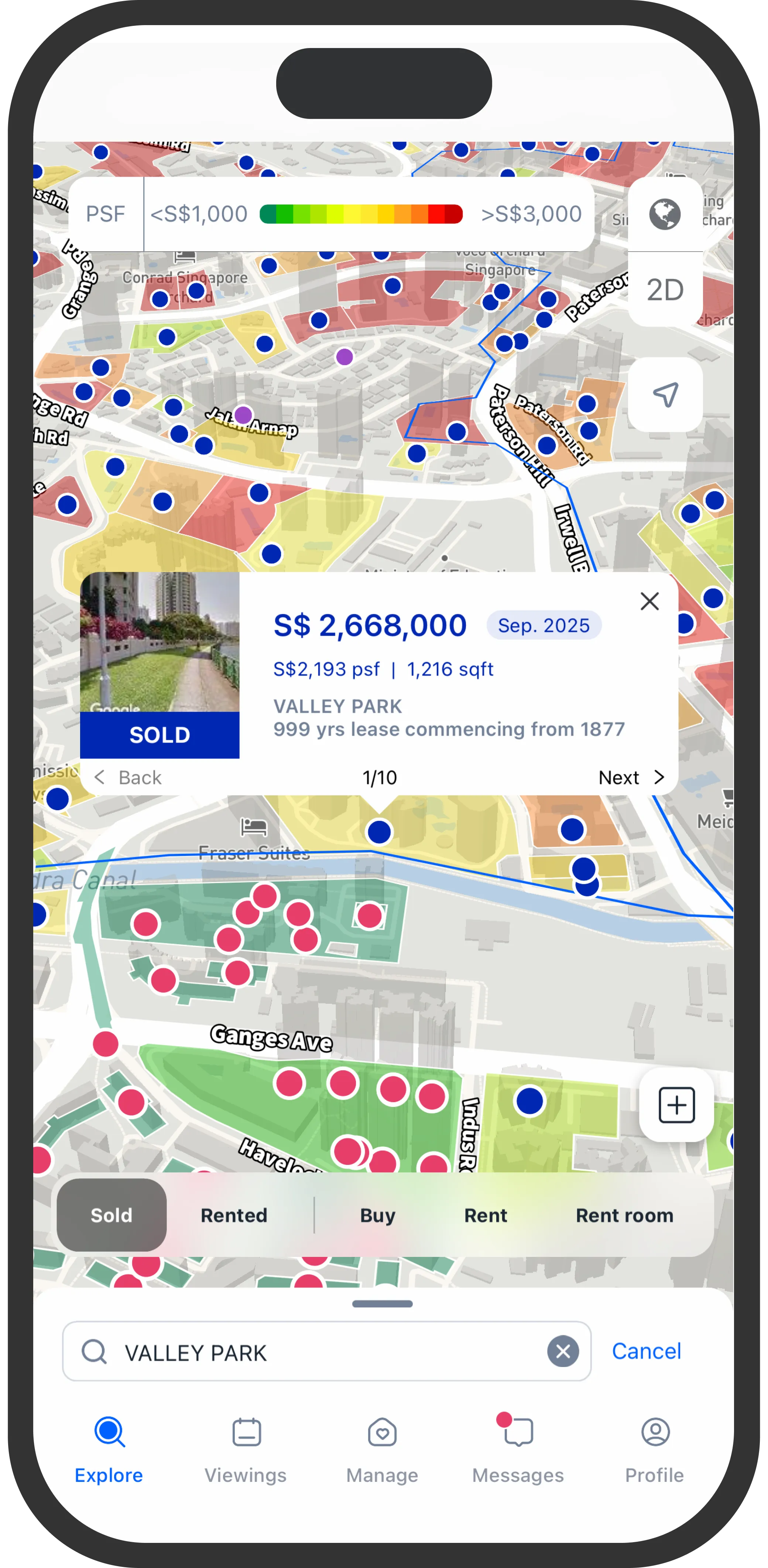
Use the Kucing Price Map to see recent Landed property transactions geographically, compare nearby streets and understand what buyers actually paid before deciding what the property in front of you is worth.
Median values are used instead of averages to reduce the influence of unusually large or expensive transactions.
For non-strata landed, URA records the area type as land, so PSF figures in this article refer to land PSF.
For strata landed, URA records strata area, so its PSF figures are not directly comparable with non-strata land PSF.
URA's public transaction database may not capture every resale or subsale because caveat lodgement is not mandatory.
From price insights to viewings and offers, Kucing helps owners, agents, buyers, and tenants move through property decisions with more clarity and control.

.png)