Renting in Singapore as an Expat: 2027 Ultimate Guide
Moving to Singapore? Learn how to rent a home, understand lease, compare neighbourhoods, understand deposits, agent fees and tenant rules in this updated 2027 expat guide

Moving to Singapore? Learn how to rent a home, understand lease, compare neighbourhoods, understand deposits, agent fees and tenant rules in this updated 2027 expat guide

Moving to Singapore in 2027? Welcome to one of Asia’s safest, best-connected and most international cities.
Finding a home here can still feel surprisingly complicated. Rental listings move quickly, terminology is unfamiliar, tenancy agreements are highly contractual, and a beautifully staged unit may reveal its quirks only after you have moved in and attempted to use the washing machine.
This guide takes you through the full rental journey, from choosing a neighbourhood and checking market rents to negotiating the tenancy agreement, documenting defects, managing repairs and recovering your deposit. It also includes practical lessons drawn from real experiences (Tenants and property agents representing tenants) in Singapore.
1. Why Singapore Remains a Magnet for Global Talent
2. Can Expats Rent Property in Singapore?
3. Visa & Eligibility Checklist
4. Current Rental Price Benchmarks
6. Where to Live: Neighbourhood Deep Dive
7. Finding Listings Like a Local
8. How to Avoid Rental Scams in Singapore
9. How to Apply for a Rental Property
10. Viewing & Inspection Blueprint
11. Negotiation & Cost-Saving Levers
12. Decoding the Tenancy Agreement
13. Move-In Day: A Zero-Stress Playbook
14. Maintenance, Repairs & Tenant Rights
15. Exit Strategy & Deposit Recovery

Singapore continues to attract international professionals, entrepreneurs and families because it combines commercial opportunity with a remarkably efficient living environment.
Beyond the skyline, residents benefit from:
Transport connectivity is also evolving. While the Thomson-East Coast Line Stage 5 and The Johor Bahru - Singapore RTS Link (making Woodlands more attractive to residents who regularly travel to Malaysia) are scheduled to open during the second half of 2026; Circle Line Stage 6 has been completed and opened.
Always verify that a planned transport project is operational before basing a lease decision on it.
2027 takeaway: Singapore housing remains expensive, but tenants are paying for connectivity, safety, infrastructure and convenience. The smartest rental decision is not necessarily the cheapest unit. It is the unit that works for your commute, lifestyle and likely length of stay.
Short answer: yes, absolutely.
Foreigners can rent private residential property in Singapore, provided they are legally entitled to reside in the country.
Private residential properties generally cannot be used for stays of fewer than three consecutive months. Short-term rentals (< 3 months) through platforms such as Airbnb are therefore not permitted in ordinary private homes.
Foreigners may also rent eligible HDB flats or bedrooms, subject to HDB rules.
Eligible HDB tenants include:
For an HDB tenancy, a foreign tenant’s pass must generally have at least six months’ validity when the owner submits the rental application. Tourists cannot rent an HDB flat or bedroom. Additional HDB rules include:
The Non-Citizen Quota is currently set at 8% at neighbourhood level and 11% at block level. It does not apply to bedroom rentals.
Before making an offer, confirm that everyone who will occupy the property has the necessary immigration documentation.
Prepare the following:
For HDB rentals, check the specific pass-validity and tenant eligibility requirements before paying a deposit.
From 1 January 2027, the minimum qualifying salary for new Employment Pass applications increases from S$5,600 to S$6,000 outside financial services. The minimum for new S Pass applications increases from S$3,300 to S$3,600. Higher age-adjusted thresholds apply to older applicants and to the financial-services sector. These changes affect employment-pass eligibility rather than the right to rent, but they may influence relocation timing and employer-sponsored housing budgets.
Do not automatically sign a lease that extends far beyond the realistic validity of your employment or immigration arrangements. A well-drafted diplomatic clause is particularly important when your right to remain in Singapore depends on your job.
Singapore rents remain elevated, but the market is no longer moving with the same ferocity seen during the post-pandemic rental surge.
The latest complete URA rental figures available when this guide was refreshed showed private residential rents rising by just 0.3% in the first quarter of 2026. Private rents had increased by 1.9% over the whole of 2025, while the vacancy rate reached 6.2% at the end of the first quarter of 2026. A substantial pipeline of new private homes is expected to be completed over the coming years.
This suggests a more balanced market heading into 2027, although well-located, renovated and family-sized homes can still attract several interested tenants.
These are broad budgeting ranges rather than valuations. Actual rent depends on floor area, age, furnishings, floor level, condition, MRT access and recent transactions in the same development.
Official HDB median rents in the first quarter of 2026 ranged considerably by town. Four-room medians were around S$3,100 in Woodlands, S$3,900 in Clementi and S$4,200 in the Central Area.
Recent market guides placed one-bedroom condominium rents at approximately S$2,800 to S$4,500 and three-bedroom condominium rents at roughly S$5,000 to S$9,000 or more. Treat these only as starting bands and check actual completed rental transactions before negotiating.
From 1 July 2024, property agents have been encouraged to follow the Best Practice Guide on co-broking commissions. This is a voluntary industry guideline, not a legal requirement. Under this model, agents representing tenants collect their commission directly from their client, the tenant.
The good-faith deposit should not disappear into contractual fog. Your Letter of Intent should clearly state whether it will become part of the security deposit, the first month’s rent or another payment.
For leases of four years or less, stamp duty is generally 0.4% of the total contractual rent.
The increased supply pipeline may give tenants greater negotiating room, especially for:
However, rents may remain resilient around international schools, major employment hubs, MRT interchanges and newly improved transport corridors.
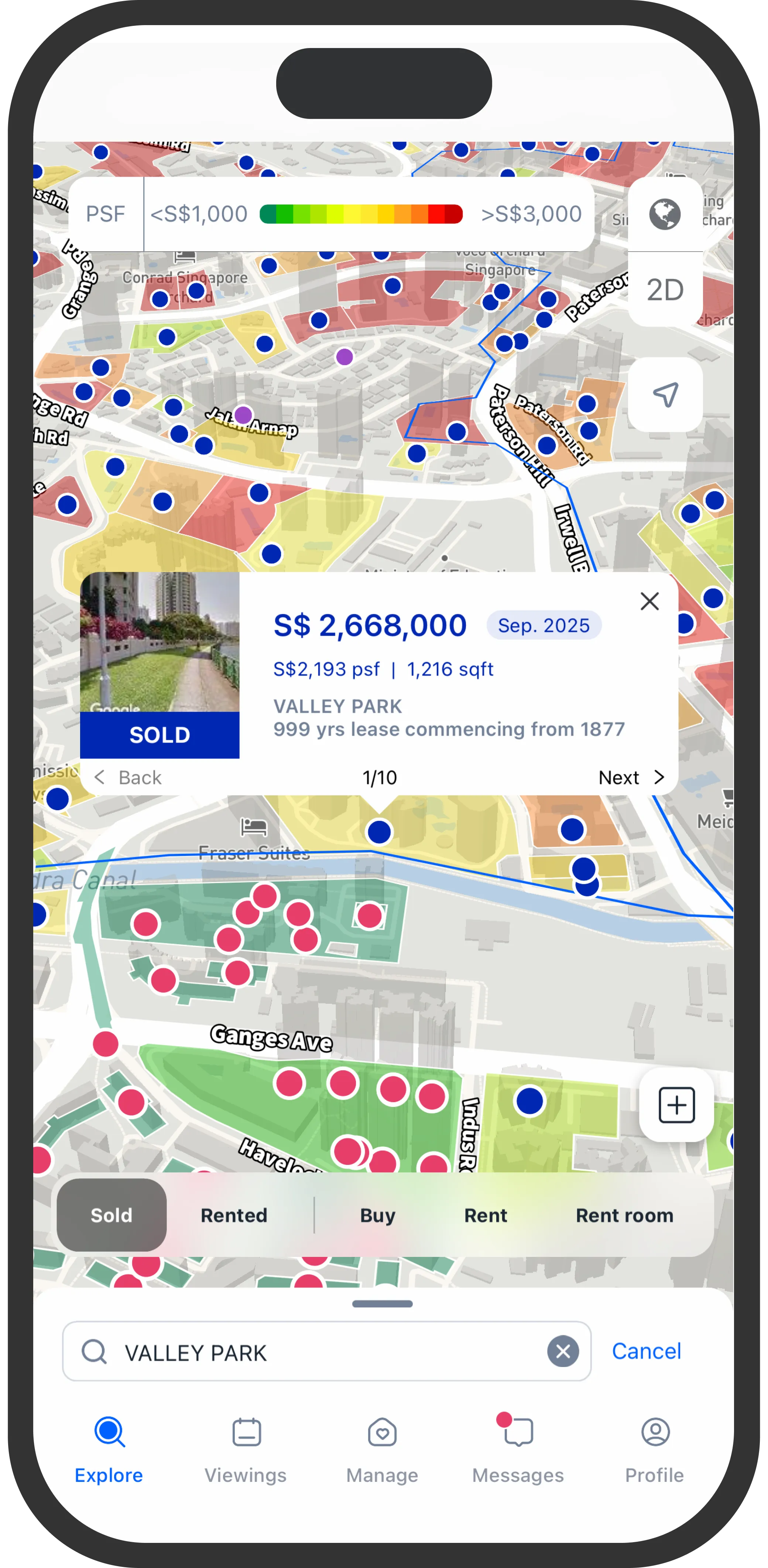
Rather than relying on island-wide averages, compare recent transactions within the same condominium, block or street. Kucing interactive rice map gives you that.
There’s no one-size-fits-all. Let’s break down your options:
HDB flats are public housing units that may be rented on the open market when the owner and tenants meet the relevant conditions.
Advantages include:
Things to check:
The temporary occupancy cap allows up to eight unrelated occupants in four-room or larger HDB flats until 31 December 2028. Only bedrooms originally constructed by HDB may be rented out. Partitioned spaces cannot legally be marketed as additional bedrooms.
Condominiums are the most familiar choice for many expatriates.Typical features include:Do not assume every condominium offers a resort experience. Check the actual condition and operating hours of the facilities, renovation activity, lift waiting times and management rules.
Landed homes include terrace houses, semi-detached houses and bungalows.They offer more space and privacy but may also involve:Inspect drains, ceilings, external walls, window seals and signs of damp particularly carefully.
Legally approved serviced apartments allow stays of 7 days or more
Co-living can offer furnished rooms, shorter commitments and an immediate social network. It is not automatically the cheapest option.Before signing, check: A room that photographs beautifully can feel very different once six occupants are sharing one kitchen and one refrigerator.
Under the updated framework, HDB flats may generally keep up to two cats and one approved small-breed dog. Private premises may generally keep up to three cats or dogs in total. Pet cats and dogs must be licensed, and the cat-licensing transition period ends on 31 August 2026. From Sept 1, 2026, keeping an unlicensed pet cat becomes an offence under the Animals and Birds Act, and standard licensing fees will apply
Government pet rules do not override your tenancy agreement or condominium by-laws. Obtain the landlord’s written consent before signing.
Choosing where to live is less about finding the “best” neighbourhood and more about finding the right daily rhythm.
Test your commute during the hours you will actually travel. A “ten-minute drive” in a listing may become forty minutes on a weekday morning.
Also check:
You’ve got four main paths:
Use them to browse listings, compare prices, and get a feel for the market.
Popular platforms:
💡 Pro tip: Be wary of scammy Facebook ads. Never transfer money before viewing.
A registered (Verify at CEA Public Register) property agent can:
Understand whom the agent represents:
This is one of the most important points for a newly arrived tenant.
The landlord’s agent represents the landlord. That agent may be helpful and professional, but their duty is to their client, not to you.
Singapore property agents cannot represent both landlord and tenant in the same transaction. An agent representing one side may assist the other with administrative paperwork with the client’s consent, but this does not turn that agent into the other party’s representative.
Many tenants choose not to appoint their own agent to save commission. That may be reasonable for someone already familiar with Singapore property practices.
For a foreigner renting here for the first time, an independent tenant agent can be valuable when negotiating:
Use a CEA Prescribed Estate Agency Agreement and define the scope clearly. Do not assume your tenant agent’s work automatically continues until the deposit is returned. Include post-tenancy-agreement support, handover assistance and deposit follow-up where those services are expected.
Useful sources include:
Off-market does not mean off-contract. Apply the same checks to a personal introduction as you would to a public listing.
Singapore’s rental market is regulated, but fake listings and agent impersonation remain real risks.
CEA specifically advises tenants to search using the phone number used by the person advertising the unit. A scammer may copy a genuine agent’s name, photograph and registration number while communicating through an unregistered phone number.
Property agents are generally prohibited from handling rental transaction monies. Payments such as rent and security deposits should normally be made directly to the intended payee.
A typical process is:
You will need to manage:
Renting without an agent is possible, but use recognised templates and do not assume that a landlord’s agent is checking the agreement from your perspective.
Do not pay a good-faith deposit until you have verified the unit and understood the refund conditions in the Letter of Intent.

A viewing should be an inspection, not a property-speed-date conducted under flattering lights.
Before signing, request:
The curtain question sounds microscopic until checkout day. Ask whether the landlord expects ordinary washing, steam cleaning or professional dry cleaning.
Take clear photographs and videos showing:
Retain the original files so the date, time and other file metadata are preserved. Store a copy outside your phone (ie: Google Drive link)
Negotiate the viewing arrangements before signing.
Specify:
Where you authorise a viewing while absent:
Rent is only one negotiable element. A slightly higher rent with a balanced tenancy agreement may be safer than a cheaper unit with aggressive clauses.
A longer lease may support a rent reduction, but it also creates a longer commitment. Do not sign 24 months solely to save a small percentage unless the termination terms work for you.
For a two-year tenancy, a diplomatic clause often becomes exercisable after the first 12 months, followed by two months’ notice. Exact wording varies.
Check:
A tenant may be required to pay minor repairs up to a stated amount per item. A range of approximately S$200 to S$250 is often negotiated, but there is no universal legal figure.
Clarify:
Negotiate at least 30 days after handover to identify pre-existing problems.
During this period, actively test:
State that defects reported during this period will be treated as pre-existing unless caused by the tenant.
A defects period should not prevent you from reporting a latent defect discovered later.
Removing old furniture can reduce clutter and future damage disputes. Record every item removed, replaced or retained.
Confirm:
Where the unit may be sold during the tenancy, negotiate access rules before signing. “Reasonable access” without notice periods or timing limits can become a revolving door.
For an expatriate who may leave Singapore before the deposit is returned, include:
A useful clause should prevent a S$50 international banking-fee surprise from nibbling at the edge of your deposit.
Key clauses to scrutinise:
Singapore does not impose one compulsory Tenancy Agreement for every residential rental. The signed contract therefore does much of the heavy lifting.
Review these clauses carefully:
Confirm the landlord’s legal identity, the exact address and all included areas such as parking spaces, storage rooms or gardens.
Check the amount, payment date, bank account, late-payment provisions and whether maintenance charges are included.
Confirm the start date, end date and handover time.
Define:
Do not assume the deposit can automatically replace the last rental payment.
Include the reporting period and how defects are to be submitted.
Attach a detailed inventory with photographs where possible. Avoid vague descriptions such as “good condition” when visible defects already exist.
Separate:
Read the trigger conditions and financial consequences, not merely the heading.
There is no universal residential rule that automatically gives every landlord a statutory right to enter on exactly 24 hours’ notice.
Set contractual rules for:
List all authorised occupants. Do not sublet or add long-term occupants without the required consent and regulatory approvals.
Obtain express written consent and record any additional cleaning or reinstatement conditions.
Define when renewal discussions begin. A fixed percentage cap can help, although some landlords may prefer renewal at prevailing market rent.
Avoid clauses requiring the unit to be returned in a condition better than at the start of the tenancy.
State clearly:
An agent may continue assisting out of goodwill, but goodwill is not the same as written authority. Unless otherwise agreed, the landlord remains the contractual counterparty.
Do not rely solely on a WhatsApp group. Send important defect, repair and termination notices through the channels specified in the agreement.
For a tenancy agreement signed in Singapore, stamping should generally be completed within 14 days of signing. An agreement signed overseas should generally be stamped within 30 days after it is received in Singapore. The tenant is normally liable unless the agreement provides otherwise.
Do not sign an unconditional handover acknowledgment until you have checked the property.
Where an immediate signature is required, note that acceptance is subject to the inventory review and defects list within the agreed reporting period.
Test the property as a home rather than a showroom.
Run full cycles on the washing machine and dryer. Use the oven and microwave. Check hot water at different times. Operate every air-conditioning unit. Open and close the curtains. Monitor drainage during heavy rain.
Send one organised defects report containing:
Ask the landlord or authorised contact to acknowledge receipt.
Open the SP utilities account before move-in where required (Inquire 2 weeks before). Retain the account-opening confirmation and initial meter readings.
The landlord’s insurance may cover the building without covering your belongings or personal liability. Consider tenants’ contents insurance from the start of the tenancy.
Check condominium registration requirements, employer-address obligations and pet-licensing rules.
Once you have moved in, visit the condominium’s management office and request a copy of the house rules or by-laws.
Condominium by-laws are legally binding rules governing residents, tenants, guests, and the use of the property. In Singapore, they operate within the framework of the Building Maintenance and Strata Management Act (BMSMA) and may be supplemented by rules introduced by the condominium’s Management Corporation Strata Title (MCST).
These rules typically cover the use of common facilities, renovation works, noise, parking, pets, move-ins and move-outs, resident conduct, and the upkeep of shared areas.
While you are there, ask for the management office’s email address and telephone number. These contact details may prove useful when reporting maintenance issues, booking facilities, arranging deliveries, or requesting approvals.
You may also be asked to provide a copy of your Tenancy Agreement or other supporting documents before receiving access cards, registering as a resident, or using the condominium’s mobile application.
.png)
Residential tenancy rights in Singapore depend heavily on the Tenancy Agreement, general contract law and the specific facts of the dispute.
Report urgent problems immediately, including:
Use written messages even when you first report the problem by phone.
Reasonable ageing is different from tenant damage. Examples may include:
The inventory and move-in photographs are your best defence against an argument conducted entirely from memory.
Keep every servicing invoice. Missing one scheduled service can create a deposit dispute even where the air-conditioning appears to work normally.
Follow the access clause in the tenancy agreement. You may propose alternative timings where a request is inconvenient, but do not unreasonably block legitimate repairs or inspections.
Send contractual notices to the landlord using the method stated in the Tenancy Agreement and copy the relevant agent.
The landlord’s agent may coordinate repairs, but that does not necessarily mean the agent has authority to approve expenditure or settle disputes.
Your own tenant agent can assist after signing where the agreed scope includes services such as:
Clarify this scope at appointment rather than discovering its limits during a leaking-ceiling crisis.
A sensible sequence is:
The Small Claims Tribunals can hear eligible disputes involving residential tenancy agreements not exceeding two years. The ordinary claim limit is S$20,000, or S$30,000 where both parties sign a Memorandum of Consent. Claims generally must be filed within two years of the event giving rise to the claim.
Longer tenancies or claims outside the tribunal’s jurisdiction may require a civil claim or legal advice.
CEA handles complaints concerning the conduct of property agents. It is not the forum for resolving every contractual disagreement between landlord and tenant.
Deposit recovery begins at move-in, not move-out.
Check:
Professional cleaning should be arranged where the tenancy agreement requires it or where reasonably needed. Do not assume every tenancy automatically requires an expensive specialist package.
Record:
Request written acknowledgment of the handover.
Ask for:
An ordinary security deposit should move directly between landlord and tenant. Property agents should not be used as informal deposit-holding intermediaries.
Agree the refund method before departure.
For the landlord’s tenancy deposit, provide verified bank instructions and confirm how international transfer fees will be allocated.
The SP utilities security deposit is separate from the landlord’s rental security deposit. When an SP account is closed, the deposit is applied against final charges and any remaining credit is refunded using the selected method. SP Group advises allowing up to 30 business days.
SP Group also provides an Authorisation and Indemnity process through which an account holder may request that a credit balance be transferred or refunded to a nominated recipient. This process should not be confused with asking a property agent to receive a landlord’s tenancy deposit.
Check & Compare Recent Rental Transactions : Kucing Price Map
Prepare for Viewings: Kucing Tenant Guide To Renting
Condo and HDB Tenant checklists : Kucing Rental Checklists
Model Tenancy Agreement Templates: Kucing official Agreement Templates
HDB eligibility to Rent: HDB eligibility for Renting a Flat
Singapore Work pass Requirements: MOM Passes & Permits
Open Utilities Account: SP Group OUA Portal
Check Non Citizen Quota for Flat Rental (HDB): HDB e-service
Explore schools based on their distance from your home : MOE School Finder
Applying for Dog or Cat license: AVS Pet Animal Licensing System
Pay Tenancy Agreement Stamp Duty: IRAS Stamp Duty Calculator
File an official claim as Tenant : Community Justice And Tribunals System
Download and complete the relevant templates before your first viewing. Documentation created while events are fresh is more persuasive than a beautifully reconstructed spreadsheet assembled six months later.

A flexible tenant may secure a home within a week. A family looking within a narrow school radius, with pets or unusual lease terms, may need several weeks.
Start researching four to eight weeks before the intended move.
Yes. Use recent completed transactions, the condition of the unit, time on market, lease length and move-in date.
A respectful evidence-based offer usually works better than simply declaring the rent too high.
Yes. Verify ownership, eligibility and payment details, and use a proper Tenancy Agreement.
Yes, eligible foreigners may rent approved whole HDB flats, subject to pass requirements, the Non-Citizen Quota, occupancy limits and HDB approval.
Government rules may permit the pet, but the landlord and condominium management may impose additional restrictions. Obtain written approval.
A flexible tenant may secure a home within a week. A family looking within a narrow school radius, with pets or unusual lease terms, may need several weeks.
Start researching four to eight weeks before the intended move.
It is not legally necessary for every tenancy, but a Singapore bank account makes rent, utilities and deposit refunds easier. Discuss alternatives before signing if you will not have one immediately.
No. The landlord’s agent represents the landlord. Appoint your own agent where you need independent advice and negotiation.
Landlords prefer SG-based GIRO transfers. Open an account within the first week of arrival.
For most residential leases of four years or less, the rate is 0.4% of the total rent, subject to the applicable IRAS rules.
The consequences depend on the diplomatic and termination clauses. You may remain liable for rent, commission reimbursement or other agreed losses.
The sale does not automatically end the tenancy. Check the agreement, whether the buyer takes the property subject to the tenancy and what viewing access you must provide.
Access depends on the Tenancy Agreement. Negotiate reasonable notice and permitted hours, except for genuine emergencies.
The sale does not automatically end the tenancy. Check the agreement, whether the buyer takes the property subject to the tenancy and what viewing access you must provide.
Request an itemised explanation and supporting evidence. Attempt written negotiation or mediation. An eligible claim under a residential tenancy of no more than two years may be filed with the Small Claims Tribunals, subject to its jurisdiction and limits.
No one can guarantee the direction of rents. Increased housing supply and higher vacancy may improve tenant choice, but strong locations and high-quality homes can remain competitive.
Use current transaction data immediately before making an offer rather than relying on an annual market prediction.
Renting a home in Singapore is relatively straightforward once you understand that the relationship is governed mainly by documents, evidence and clearly allocated responsibilities.
Verify whom every agent represents. Inspect rather than merely view. Negotiate the unglamorous clauses. Test every appliance. Preserve your photographs. Keep your servicing receipts. Send formal notices to the correct party.
The keys to a smooth tenancy are rarely the literal keys. They are the paper trail sitting quietly behind them.
Use Kucing to explore Singapore rental listings, compare nearby transactions and prepare for each stage of your tenancy, from the first search to the final handover.
2027 edition. Market and regulatory sources checked on 19 July 2026. Rental figures, immigration requirements and regulations should be rechecked before publication and before entering a tenancy.
From price insights to viewings and offers, Kucing helps owners, agents, buyers, and tenants move through property decisions with more clarity and control.